
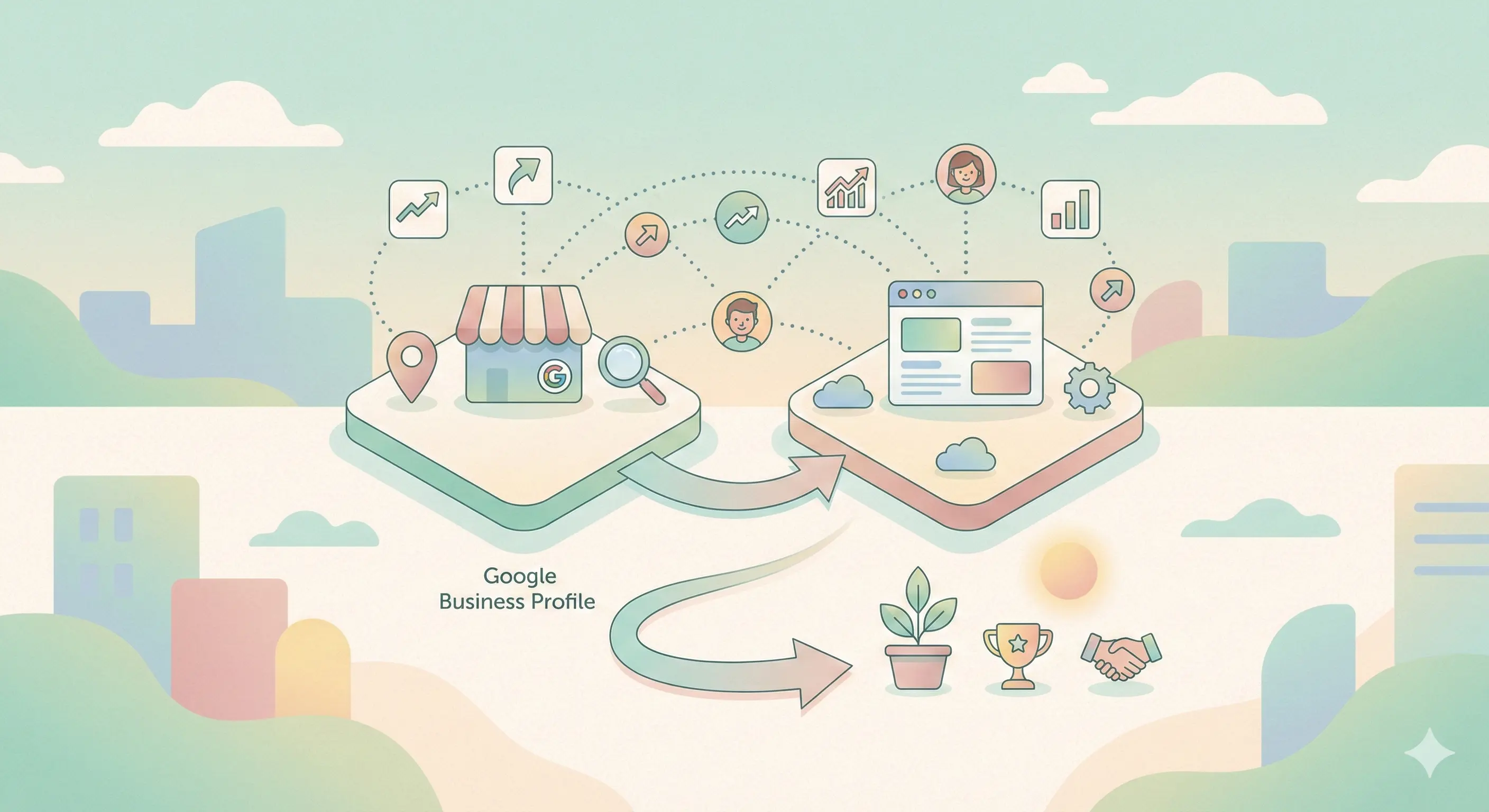
Google Business Profile SEO: Win More Local Clients in 2026
Transform your GBP into a client magnet. Learn how to dominate local search by connecting your website and Google Business Profile. Real tactics that work.


Let’s be blunt. You’ve spent time optimizing your Google Business Profile (GBP). You’ve invested in a professional website. Yet, they feel like two separate employees who don’t talk to each other; one handles walk-ins, the other handles appointments, and potential clients are falling through the cracks in between.
This is the core frustration for most service-based firms. Your GBP and website operate as isolated islands. This inconsistency confuses Google, creates a choppy experience for clients, and ultimately silences your phone and empties your contact form.
Here’s the mindset shift you need: Your GBP and website are not separate marketing channels. They are the fundamental components of a single, powerful Local SEO ecosystem. When woven together strategically, they build an authoritative local presence that dominates search results and systematically converts searchers into clients.
This guide will show you, step-by-step, how to build that system. We’ll move beyond basic optimization into strategic integration, the kind that builds a business, not just a listing.
Why Your GBP and Website Must Work as One System
Think of your local online presence as building a skyscraper of trust. Your website is the deep, reinforced foundation. Your Google Business Profile is the gleaming, visible tower that everyone sees from the street. If the foundation and the tower are made of different materials, engineered to different specs, the whole structure is weak. But when they’re built as one integrated unit, they become unshakable.
Google’s entire ranking philosophy for local search hinges on confidence. Can Google confidently present your business as the best, most relevant, and most trustworthy answer to a local searcher’s query? A cohesive ecosystem between your GBP and your website is the primary way you build that confidence.
Here’s what happens when they work in harmony:
-
You Supercharge E-E-A-T: Google’s mantra of Experience, Expertise, Authoritativeness, and Trustworthiness is validated through consistency. When your website’s detailed service pages echo the expertise shown in your GBP posts and Q&A, it’s a powerful signal.
-
You Create a Stronger Local Search 'Entity': Google doesn’t just see a listing and a website. It sees a unified "business entity." Consistent NAP (Name, Address, Phone), imagery, keywords, and review sentiment across platforms make that entity look solid, legitimate, and authoritative.
-
You Design a Seamless User Journey: A potential client discovers you in the local pack (GBP). They click to your website for more details. If the messaging, visuals, and promises align perfectly, their trust compounds, and they convert. If they hit a disconnect, they hit the back button.
-
You Maximize Every Asset: A great review on your GBP shouldn’t live only there. A brilliant "About Us" page on your website shouldn’t be hidden from your GBP searchers. Integration means each piece of content pulls double duty.
Example: Here is one Real Estate Agency, Searched "real estate agent in california" and got this result in first place.
Anderson Real Estate Group
5 ⭐⭐⭐⭐⭐ (490 reviews)
20+ years in business
On-site services · Online appointmentsThey have an excellent Google Business Profile, and the Anderson Group website also contains the agency's Name, Address, and Phone number.
The Signal Amplification Effect
This is the technical heartbeat of the ecosystem. Local search signals are reinforced when they’re echoed across your owned platforms.
For example, if your GBP is consistently receiving reviews that mention "fast claim resolution" (for an insurance agency) or "stress-free home buying" (for a realtor), Google registers that as a core theme. Now, if your website’s service pages and blog content are also densely and naturally optimized around those same phrases, the signal is amplified. Google thinks, "This business is definitively about fast claim resolution, their clients say it, and their own content proves it." This isn’t manipulation; it’s clarity. You’re telling Google, and your clients, exactly what you excel at, loudly and clearly.
Closing the Loop on Lead Attribution
For the founder, this is about ROI. A disconnected setup makes attribution a nightmare. Did that new client come from the GBP call button or the website form?
A connected ecosystem, tracked properly with UTM parameters and conversion tracking tools, lets you see the journey. You can see that a user found you via a "personal injury lawyer Boston" search, viewed your GBP, clicked to your website's "Car Accident Claims" page, and then filled out a contact form. This isn’t just data, it’s your roadmap. It tells you which parts of your ecosystem are driving business, so you can double down on what works.
Example: Searched "Car accident claims in boston" and got this result at first place in GBP.
Jeffrey Glassman Injury Lawyers
4.9 ⭐⭐⭐⭐⭐ (682 reviews)
30+ years in business · 1 International Pl #1810
Open 24 hours · +1 617-865-7000
Their website mentions auto accident claims
Audit & Align: The Foundation of Your Ecosystem
You can’t integrate what you haven’t inventoried. Before we connect any wires, we need to ensure both components are singing from the same hymn sheet. This isn’t about flashy tactics; it’s about meticulous, boring, and critically important foundational work.
Start with a core data consistency audit. Inconsistency here is a direct trust signal to Google but a negative one. It suggests your business is unprofessional or, worse, not legitimate.
Your action items here are:
-
Audit and align your NAP (Name, Address, Phone Number) across every surface: GBP, website header/footer, contact page, and major directories like Yelp or Yellow Pages.
-
Ensure your business hours are perfect. Nothing kills trust faster than showing as "Open" on GBP when your website says you're closed.
-
Verify your primary and secondary business categories on GBP align with the services you prominently feature on your website.
-
Analyze your Visual identity. Do the professional headshots on your website match the grainy, 10-year-old photo on your GBP? Do your logo and color scheme feel like the same company?
Example: Seached "Accountants on New York" and got this result at first place
George Dimov CPA
4.7 ⭐⭐⭐⭐⭐ (489 reviews)
Certified public accountant · Tax consultant in New York
Closed · Opens 7 am · +1 212-641-0673
They specified everything in their GBP like Name, Address, Phone number, Blogs, Reviews, Social media accounts, Popular Timing slots, Photos etc.
The Core Data Consistency Checklist
Print this out. Check each box.
| Platform | What to Check | Ideal Status |
|---|---|---|
| Google Business Profile | Business Name, Phone, Address | Exact, official legal name. Local phone number. Precise address. |
| Website Footer | Business Name, Phone, Address | Must match GBP exactly. No abbreviations (e.g., "St." vs "Street") unless both use it. |
| Website Contact Page | Business Name, Phone, Address | Must match GBP exactly. Include a linked phone number. |
| Major Directory (e.g., Yelp) | Business Name, Phone, Address | Must match GBP exactly. Claim and update all listings. |
| All Platforms | Business Hours | Identical opening/closing times for each day. Special holiday hours updated in advance. |
| All Platforms | Primary Business Category | Chosen category must be the core service your website promotes. |
Keyword Mapping: From GBP to Website Pages
Your GBP Insights is a goldmine of search query data. It tells you what people are typing in to find you. This intelligence must fuel your website content strategy.
Here’s the process:
-
Go to your GBP dashboard, navigate to Performance > Search queries.
-
Identify the top 10-15 searches that drive views and actions. These are your core local keyword themes (e.g., "emergency plumber Toronto," "family law attorney Sacramento," "SEO agency for contractors").
-
For each of these primary keyword themes, you must have a dedicated, optimized page on your website.
- Is "emergency plumber Toronto" a top query? You need a service page titled "24/7 Emergency Plumbing Services in Toronto."
- Is "probate lawyer" a top query? You need a detailed "Probate & Estate Administration" service page.
This alignment tells Google your website is the deep-dive resource for the very services your GBP is being found for. It completes the loop.
Strategic GBP Optimization to Fuel Your Website
Now that our foundation is solid, we turn your GBP from a static business card into a dynamic funnel that actively directs high-intent traffic to your website. Most businesses fill out the basics and stop. You’re going to use it as a publishing and engagement platform.
Move beyond the basics. Use every feature with the intent to guide users deeper into your ecosystem:
-
GBP Posts: Treat these as mini-blog promotions or announcements. They’re not just for holiday hours.
-
Q&A: This is a pre-emptive customer service and SEO goldmine. Don’t leave it to chance.
-
Products/Services Menu: Use this to create a direct, clickable table of contents for your website’s service offerings.
-
Description: Write a keyword-rich, benefit-driven narrative that speaks directly to your client’s pain points, mirroring the tone of your website.
Example: Searched "car garage in los angeles" and got this result at first place and it's perfect GBP for Automotiv Workshop.
One Stop Auto Care
4.9⭐⭐⭐⭐⭐ (423 reviews) · Auto repair shop
35+ years in business · 4695 N Eagle Rock Blvd
Closed · Opens 8 am · +1 323-257-5876
Using Posts as a Content Funnel
Your GBP Posts (Updates, Offers, Events) have a short shelf-life but high visibility in your profile. Use them strategically to promote your deepest website content.
Instead of a generic post saying: "We do great work!" Create a post that says: "Just published: Our definitive guide to navigating a denied insurance claim. Learn the 5 steps you can take before calling an attorney. [Link to your website's blog post]"
This does three things: 1) It provides immediate value, 2) It establishes expertise, and 3) It drives a user who is already interested in your GBP directly to a conversion-optimized page on your site. Do this weekly with new blogs, case studies, or service highlights.
Pre-emptive Q&A for Common Client Questions
The Q&A section often gets filled with random public questions. Take control. Populate it yourself with the questions you hear every single day.
-
Question: "What should I bring to my first estate planning consultation?"
-
Your Answer: "Great question! We recommend bringing A, B, and C. For a complete checklist, visit our detailed guide on our website: [Link to 'Preparing for Your First Meeting' page]."
-
Question: "Do you service the [Suburb Name] area?"
-
Your Answer: "Yes, we proudly serve all of [Metro Area], including [Suburb Name]. You can see our full service area map and check coverage for your specific address here: [Link to your 'Service Area' page]."
This demonstrates incredible proactive service, saves you time, and Critically creates multiple contextual links from a highly trusted Google property directly to the most relevant pages on your website. This is powerful SEO.
Website Enhancements That Leverage GBP Authority
Your website must be built to receive and convert the traffic your GBP sends. It must also actively pull credibility from your GBP to build trust on the spot. This is where you close deals.
Key enhancements include:
-
Embedding Your GBP Reviews: Social proof is everything. A static testimonial page is good. A live, scrolling widget of your latest 5-star Google reviews is transformative for trust.
-
Creating Local Service Area Pages (LSAPs): If you serve multiple towns or neighborhoods, create a dedicated page for each. A page optimized for "Financial Advisor in [Town Name]" that provides specific, local context is a massive ranking signal and feels personal to the searcher.
-
Addressing Pain Points Directly: Scour your GBP reviews and Q&A. What are clients praising or complaining about? Structure your website copy to directly address these points. If reviews praise your "clear communication," your website's "Our Process" page should have a section titled "Transparent Communication at Every Step."
-
Technical SEO for Local Intent: Speed, mobile-friendliness, and clear structure are non-negotiable. A searcher on their phone needs to find your address, see your reviews, and call you within 10 seconds.
Implementing Local Business Schema
Schema markup is code you add to your website that tells search engines explicitly what your content is about. For a local business, implementing LocalBusiness schema on your contact page is like giving Google a perfectly formatted business card that connects directly to your GBP entity.
This doesn't require you to be a coder. Many SEO plugins (like Rank Math, Yoast SEO Pro, or Schema Pro) can generate this for you. The key properties to ensure are included are:
@type: LocalBusinessname,address,telephone: (Must match your GBP exactly!)geo(latitude/longitude)openingHourspriceRangesameAs(This is a crucial link to your GBP and other social profiles)
This schema creates a formal link in Google’s eyes between your website and your GBP, solidifying the "entity" we talked about.
Designing Conversion Paths from Local Content
A user lands on your "Water Damage Restoration in Miami" page, which you built because "water damage Miami" is a top query in your GBP Insights. What now?
The page must have a crystal-clear, contextually relevant call-to-action (CTA). A generic "Contact Us" button is weak.
Strong, local-intent CTAs are:
- "Get Your Free Damage Assessment in Miami"
- "Schedule a 24/7 Emergency Call-Out"
- "Download Our Miami-Specific Storm Preparedness Guide" (in exchange for an email)
The CTA must flow naturally from the page's intent. The user is in a problem-state ("my basement is flooded"). Your page provides the solution expertise, and the CTA is the immediate, logical next step to solve their problem. This is how you convert local search traffic into leads.
The Maintenance Flywheel: Content, Reviews, & Analytics
An ecosystem is not a "set it and forget it" project. It’s a living system that thrives on consistent, minimal input a flywheel. A small, regular effort creates compounding momentum.
Your ongoing system should include:
- A Monthly Content Calendar: Plan one piece of cornerstone website content (a blog, a guide, a case study). Then, use GBP Posts to promote it at least 2-3 times that month from different angles.
- A Review Generation Process: After a successful client engagement, have a systematized, gentle email follow-up asking for a Google review. Feature new, stellar reviews on your website via your widget.
- Dedicated Analytics Monitoring: Don’t guess. Every month, check GBP Insights for search query trends and which posts got traction. In conversion tracking, look at traffic from your GBP and see which pages they visited and converted on.
- Agility: If you see a new question popping up in GBP Q&A, add it to your pre-emptive list and consider writing a short blog post to address it fully.
Monthly Ecosystem Health Check
Set a calendar reminder for the first Monday of every month. Run through this 15-minute checklist:
- NAP Spot-Check: Quickly Google your business name. Does the info in the knowledge panel (GBP) match your website footer?
- Review Response: Have you responded to all new Google reviews from the past month? (Thank the positive, professionally address the negative).
- Post Something: Create at least one new GBP Post linking to a useful piece of website content.
- Q&A Scan: Check the GBP Q&A section for new public questions and answer them promptly.
- Insights Glance: Open GBP Insights. What was the top search query last month? Does your website have a strong page for it?
Measuring What Matters: From Clicks to Clients
Forget vanity metrics. Track these KPIs to gauge the health and ROI of your ecosystem:
-
Impressions in Local Search (GBP Insights): Are you being seen more? This is brand visibility.
-
Website Clicks from GBP (GBP Insights): Are people moving from your listing to your site? This measures funnel effectiveness.
-
Direction Requests & Calls from GBP: These are high-intent leads. Track volume.
-
Conversions on Local-Focused Website Pages (conversion tracking): Set up goals in conversion tracking for form submissions or phone calls on pages like
/service-areas/springfield/or/emergency-plumbing/. This tells you if your content is converting. -
Overall Organic Search Traffic for Local Keywords (conversion tracking): Are you ranking better and attracting more direct organic traffic for terms you care about?
Conclusion: Building Your Unshakable Local Presence
Your Google Business Profile and your website are not two tools. They are the core components of a single, authoritative local presence. By treating them as an interconnected ecosystem, auditing for consistency, optimizing for synergy, and maintaining with purpose; you build a system that is far greater than the sum of its parts.
This system doesn’t just ask Google for rankings; it demonstrates undeniable authority and trustworthiness. It doesn’t just hope for clients; it creates a seamless, persuasive journey that guides them to choose you.
Stop letting disconnected efforts limit your growth. The bridge between being found and being chosen is the ecosystem you build. If this feels like the right strategy but a full-time job you don’t have, let’s talk. Our agency specializes in building and maintaining these cohesive local SEO systems for service firms like yours. Book a 30-minute strategy audit today to see how your current ecosystem holds up and what your first, most impactful step should be.
Frequently Asked Questions (FAQ)
Q1: How long does it take to see results from integrating my GBP and website?
A1: Local SEO is faster than traditional SEO, but it's not instantaneous. For foundational corrections like NAP consistency, you might see a positive shift in verification and trust signals within a few weeks. For strategic integration (schema, content alignment, review embedding) to impact rankings and lead volume, allow for a consistent 3-6 month period. Remember, you're building a system, not applying a quick fix.
Q2: I'm a service-area business (SAB) without a public address. Does this ecosystem still apply?
A2: Absolutely, and it's perhaps even more critical. For SABs, your GBP and website are your primary storefronts. Consistency in service areas listed on both platforms is your version of NAP. The synergy of reviews, Q&A, and service-focused content is vital to proving your local expertise in the towns you serve. Ensure your website has clear "Service Area" pages for each major location.
Q3: My website is on a simple builder like Wix/Squarespace. Can I still implement this?
A3: Yes, you can implement 90% of this strategy. You can ensure NAP consistency, create local content pages, embed Google reviews (using their provided embed code), and align keywords. The main limitation might be advanced technical implementations like custom schema markup without plugins, but many website builders now have apps or built-in features for basic business schema. Start with the strategic and content alignment, that's where most of the value is created.
Thanks for reading! ❤️
Written by
JenishRead Next


Turn this into your AI Search strategy
LLaMaRush creates SEO, AEO, and GEO optimized content built to rank in Google and get cited by AI answer engines.
Start Ranking Everywhere