
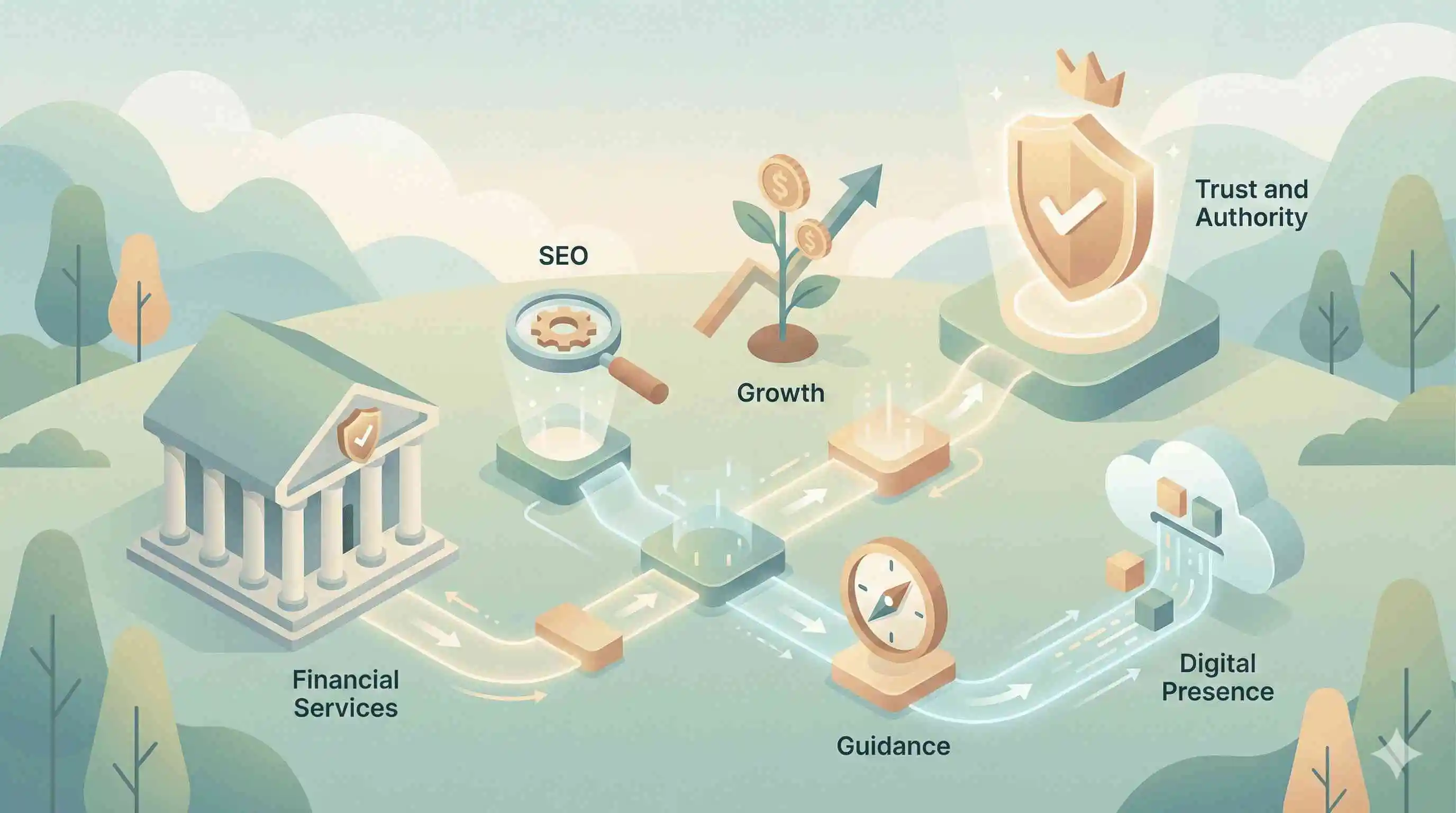
Financial Services SEO: Build Trust & Rank Higher in 2026
You know your services are valuable. You've seen the impact you can have on clients' financial well-being. Yet, when someone in your area searches for "financial advisor near me" or "how to plan for retirement," your website is nowhere to be found. This isn't just an oversight; it's a critical business problem.
SEO for financial services isn't about tricking search engines. It's a disciplined process of building digital trust and topical authority in an industry where compliance, competition, and consumer skepticism are high. The very barriers that make it challenging strict regulations, complex products, the need for immense credibility are what make it so powerful when done correctly. Your competitors are often intimidated by it. This is your advantage.
This guide provides no theory, only action. It is a blueprint for constructing an online presence that search engines recognize as an authoritative resource and that prospective clients see as a beacon of guidance. Every section contains direct, implementable advice.
The Unshakeable Foundation – Technical SEO and Strategic Keyword Research
You cannot build a skyscraper on sand. Before you write a single article, your technical base must be solid, fast, and secure. Simultaneously, you must understand the precise language your potential clients use.
Conduct a Comprehensive Technical Health Audit
Your website's infrastructure must be flawless. Search engines and users penalize slow, broken, or insecure sites.
-
Audit Your Site Speed: Use Google PageSpeed Insights and GTmetrix. These tools don't just give you a score; they provide specific fixes. Prioritize:
- Compressing and properly sizing images (use WebP format).
- Eliminating render-blocking JavaScript and CSS.
- Leveraging browser caching.
-
Ensure Mobile-First Compatibility: Over 60% of searches happen on mobile. Use Google's Mobile-Friendly Test. Ensure buttons are tap-able, text is readable without zooming, and the mobile experience is not an afterthought.
-
Master Google Search Console: This is your direct line to Google. Verify your site. Use it to:
- Identify and fix indexing errors (coverage report).
- Submit your sitemap.
- Understand which queries already bring impressions and clicks.
-
Eradicate Broken Links: Use a crawler like Screaming Frog SEO Spider (free for up to 500 URLs) to find broken internal links (404 errors) and redirect them properly. Broken links harm user experience and waste "crawl budget."
Develop a "Problem-First" Keyword Strategy
Forget targeting generic service terms. Your prospects are searching for solutions to their worries and questions.
-
Categorize by Search Intent:
- Informational: "What is a backdoor Roth IRA?" "difference between term and whole life insurance."
- Navigational: "Vanguard login," "[Your Firm Name] reviews."
- Commercial: "best low-fee index funds 2024," "compare robo-advisors."
- Transactional: "hire a financial planner in [Your City]," "open a Roth IRA account."
-
The Actionable Research Process:
-
Seed List: Start with your core services (retirement planning, tax strategy, estate planning).
-
Expand with Tools: Use keyword explorer and keyword difficulty checker tools to find the best keyword for your domain. Focus on "Questions" and "Also rank for" suggestions.
-
Prioritize Long-Tail, Low-Competition Phrases: "How to roll over old 401k to new employer" is far more actionable and easier to rank for than "401k."
-
Organize in a "Keyword Map": Create a spreadsheet. Columns should include: Target Keyword, Search Intent, Priority (High/Med/Low), Target Page URL, and Notes. This becomes your content master plan.
-
Implement a Simple, Scalable Compliance Framework
Compliance is non-negotiable. Integrate it into your workflow, not as a barrier, but as a quality filter.
-
Create a Clear Content Workflow: Establish a simple process:
Outline > Draft > Compliance Review (for flagged terms/claims) > Final Edit > Publish. This prevents bottlenecks. -
Develop Standard Disclaimers: Craft approved disclaimer language for different content types. Place it visibly on all service pages and at the bottom of blog posts. Example: "This content is for informational purposes only and is not intended as financial advice..."
-
Use Compliance to Enhance Trust: View compliance checks as a way to ensure accuracy. Accurate, compliant content is inherently more trustworthy to both users and search engines.
The Content Engine – Creating Assets That Build Trust and Capture Intent
Content is your primary tool for demonstrating expertise and capturing search traffic. It must be genuinely helpful, deeply relevant, and structured for both users and search engines.
Build a "Top of Funnel" Content Library
Attract prospects early in their journey by solving their immediate problems.
-
Create Definitive "Explainer" Guides: Become the go-to resource for understanding complex topics. Target high-value informational keywords.
- Example Structure for "What is a Roth IRA?": Simple definition, key benefits, eligibility rules, contribution limits, withdrawal rules, Roth vs. Traditional comparison table, FAQs.
-
Develop "Financial Milestone" Content: Align your content with life events that trigger financial planning.
- Topics: "Financial Planning Checklist for New Parents," "Navigating a Job Loss: A Financial Guide," "First-Time Home Buyer's Financial Checklist," "Pre-Retirement Checklist: 10 Years Out."
-
Answer Local Questions Proactively: Combine local SEO with helpful content. Write detailed guides like "A Guide to Retirement Planning for Residents of [Your City]" mentioning local considerations, costs, or programs.
Optimize Your Core Service Pages for Conversion
Your service pages ("Financial Planning," "Investment Management") must rank and convert.
-
Structure with Clear Sections: Use H2/H3 headers for scannability: Overview, Who It's For, Our Process, Your Questions Answered, Next Steps.
-
Incorporate Keyword Variations Naturally: Include your primary and secondary keywords in the title, headers, and body text, but write for the human reader first.
-
Feature Strong, Unique Value Propositions (UVPs): Don't just say "we provide financial planning." Say "We provide a personalized financial roadmap for tech professionals in [Your City] navigating stock options and rapid income growth." Specificity attracts your ideal client.
-
Include Clear, Compelling Calls-to-Action (CTAs): Every service page should have a primary CTA ("Schedule a Complimentary Consultation") and a secondary CTA ("Download Our Guide to [Related Topic]").
Master On-Page SEO for Every Piece of Content
Technical on-page elements tell search engines exactly what your page is about.
-
Craft Compelling Title Tags: Include the primary keyword near the front. Keep under 60 characters. Add a benefit or trigger: "Retirement Planning in [City]: A 7-Step Strategy for Confidence" vs. just "Retirement Planning."
-
Write Persuasive Meta Descriptions: This is your ad copy in search results. Summarize the page's value, include keywords, and use a clear CTA. Aim for 150-160 characters.
-
Use Header Tags (H1, H2, H3) Logically: Your H1 is the main title. Use H2s for major sections and H3s for sub-sections. Incorporate keywords naturally into headers.
-
Optimize Images: Use descriptive file names (
roth-ira-contribution-limits-2024.jpg), notIMG_1234.jpg. Always fill out the Alt Text field, describing the image for accessibility and SEO.
Building Unquestionable Authority – Signals That Make Google Trust You
Google's E-E-A-T (Experience, Expertise, Authoritativeness, Trustworthiness) is the cornerstone of ranking in YMYL (Your Money Your Life) niches. You must proactively demonstrate it.
Execute a Principled Link Building Strategy
Backlinks are votes of confidence from other websites. Earn them through value.
-
The Expert Commentary Method: Monitor news for financial trends (Fed meetings, new tax laws). Write a unique, insightful take and pitch it to journalists via Help a Reporter Out (HARO) or directly to finance editors at local/industry publications.
-
The Resource Link Outreach: Identify high-quality, relevant local directories (Chamber of Commerce) or industry resource pages. If they list competitors, politely request inclusion, presenting your superior credentials or content.
-
Create "Linkable Assets": Develop one cornerstone piece of content so valuable others want to link to it. This could be an original research report ("2024 Retirement Confidence Survey in [Your State]"), a sophisticated financial calculator, or the definitive guide mentioned in Action 4.
Showcase E-E-A-T On Every Page
Weave proof of your expertise into the fabric of your site.
-
Create Robust "About Us" and "Team" Pages: Feature professional bios with credentials (CFP®, CFA®, CPA), professional photos, and personal narratives that explain why you do this work. Link to individual team member pages.
-
Implement Author Bios and Bylines: Every blog post should be attributed to a specific expert with a linked bio. This associates content with a credible individual, not a faceless corporation.
-
Systematically Collect and Display Testimonials: With compliance approval, feature client testimonials that speak to process and results. Use schema markup to make them eligible for rich results.
-
Display Trust Badges and Certifications: Logos of professional organizations (NAPFA, FPA), security seals, and well-known custodians (Schwab, Fidelity) provide instant visual trust cues.
Dominate Local Search Visibility
For most advisors, local SEO is the fastest path to qualified leads.
-
Claim and Optimize Your Google Business Profile (GBP): This is critical. Complete every section: services, description, hours, photos. Use the Q&A feature proactively. Post regular updates (market insights, firm news) directly to your GBP.
-
Build Consistent Name, Address, Phone (NAP) Citations: Ensure your firm's name, address, and phone number are identical across the web (Chamber of Commerce, Yelp, FINRA BrokerCheck, industry directories). Use a tool like BrightLocal to audit and clean citations.
-
Encourage and Manage Reviews: Politely ask satisfied clients to leave a review on your Google Business Profile. Respond professionally to all reviews, thanking positive reviewers and addressing any concerns raised in negative reviews publicly and professionally.
Measurement and Iteration – Tracking What Actually Matters
Move beyond vanity metrics. Focus on data that correlates directly with business growth.
Implement Advanced Tracking with Google Tools
Set up the infrastructure to measure performance correctly.
-
Configure Google Analytics 4 (GA4) for Conversions: Define key actions as "events." This includes:
- Consultation form submissions.
- Guide or whitepaper downloads.
- Clicks to key service pages from blogs.
- Phone calls (via call tracking numbers).
-
Use Google Search Console for Search-Specific Insights:
Monitor:
- Click-Through Rate (CTR): If you have high impressions but low clicks, your Title and Meta Description need improvement.
- Average Position: Track movement for your target keyword groups.
- Queries: Discover new, unexpected search terms bringing traffic.
-
Leverage Schema Markup: This structured data helps search engines understand your content.
Implement:
- Local Business Schema on your contact page.
- FAQ Schema on pages with question lists.
- Review Schema for testimonials.
- Person Schema for team member bios.
Analyze and Report on Core Performance Indicators (KPIs)
Create a simple monthly dashboard tracking these metrics:
-
Organic Traffic Growth: Month-over-month and year-over-year trends from GSC, GA4.
-
Keyword Rankings for Target Phrases: Track a focused list of 20-50 high-intent keywords (informational and transactional) using your SEO tool.
-
Conversion Rate from Organic Search: (Total Organic Conversions / Total Organic Sessions) from GSC, GA4. This tells you if your traffic is qualified.
-
Authority Metrics: Domain Authority (DA) or Domain Rating (DR) as a general trend line, and the number of new, high-quality referring domains.
-
Local Pack Visibility: How often you appear in the local 3-pack for your core service + city searches.
Conduct a Quarterly SEO Retrospective and Pivot
Every quarter, review your dashboard and ask:
-
What content drove the most traffic/conversions? Double down on that topic or format.
-
What keywords are we moving up for? Can we create more content around related subtopics?
-
Where are we losing clicks (high impressions, low CTR)? Revise page titles and meta descriptions.
-
What's a new question prospects are asking? Use "People also ask" boxes and forum research to ideate new content.
Conclusion: Your Path to Sustainable Search Dominance
SEO for financial services is not a marketing tactic; it is the systematic online application of your professional principles: Diligence,Expertise, Transparency, and a focus on client needs. By executing the actions in this guide building a technically sound foundation, creating relentlessly helpful content, actively demonstrating Your authority, and by measuring real-world results, you construct more than just a ranking. You build a digital flagship that attracts the right clients, builds trust before the first meeting, and establishes your firm as the undisputed expert in your market.
The process begins with a single action. Choose one:
- Run your site through Google PageSpeed Insights and fix the first recommended priority.
- Open a spreadsheet and map out 10 "problem-first" long-tail keywords.
- Write the first draft of a definitive explainer article for a common client question.
Begin. Then iterate. Consistency in applying these actionable steps is what will separate your firm from the competition, now and for the long term.
Frequently Asked Questions
Q1: What makes SEO for financial services different from other industries in 2026?
A1: Financial services SEO is uniquely challenging because it falls under Google’s YMYL (Your Money or Your Life) category. This means Google applies stricter quality standards, prioritizing E‑E‑A‑T (Experience, Expertise, Authoritativeness, Trustworthiness) above all. Additionally, financial advisors face compliance regulations (e.g., SEC, FINRA) that restrict claims and require disclaimers. The competitive landscape is also fierce, national brands dominate generic terms like “financial advisor.” However, this creates an opportunity: by targeting long‑tail, problem‑first keywords (e.g., “how to roll over old 401k to new employer”), building local authority, and demonstrating genuine expertise through detailed content, independent advisors can outrank larger firms. Trust signals (reviews, credentials, transparent bios) are non‑negotiable ranking factors.
Q2: How do I find low‑competition, high‑intent keywords for financial planning SEO?
A2: Avoid generic terms like “retirement planning.” Instead, focus on long‑tail, conversational keywords that reveal specific user intent. Use this process:
-
Start with your core services and common client questions.
-
Use free tools like AnswerThePublic and Google’s “People Also Ask” to find real questions.
-
Prioritize informational intent keywords (“what is a backdoor Roth IRA,” “difference between term and whole life”) for blog content, and commercial intent (“best low‑fee index funds,” “fee‑only financial planner in [City]”) for service pages.
-
Create a keyword map spreadsheet with columns for keyword, intent, priority, and target page.
Long‑tail phrases like “how to roll over old 401k to new employer” have lower search volume but much higher conversion potential and less competition than head terms.
Q3: How can a financial advisor build E‑E‑A‑T to rank higher in Google’s YMYL space?
A3: E‑E‑A‑T (Experience, Expertise, Authoritativeness, Trustworthiness) is critical for financial YMYL content. Actionable steps:
-
Experience – write from real client scenarios, case studies (with permission), and personal insights.
-
Expertise – create detailed “About Us” and “Team” pages with professional bios, credentials (CFP®, CFA®, CPA), photos, and linked author bylines on every blog post.
-
Authoritativeness – earn backlinks from reputable finance sites, local chambers, and industry publications via HARO (Help a Reporter Out) or original research.
-
Trustworthiness – display trust badges (NAPFA, FPA), security seals, clear disclaimers, transparent pricing, and collect Google reviews. Each piece of content should be fact‑checked, cited, and compliant. Google’s algorithm rewards sites that proactively prove credibility.
Q4: What is the most effective local SEO strategy for a financial advisor in 2026?
A4: Local SEO is the fastest path to qualified leads for advisors. Follow this checklist:
-
Claim and fully optimize your Google Business Profile (GBP) – complete every field: services, description, hours, photos, and use the Q&A feature. Post regular updates (market insights, firm news).
-
Ensure NAP consistency – your Name, Address, Phone must be identical on your website, GBP, and all directories (Yelp, Chamber of Commerce, FINRA BrokerCheck).
-
Collect and manage Google reviews – politely ask satisfied clients for reviews; respond to every review professionally.
-
Create local content – write guides like “Retirement Planning for Residents of [Your City]” mentioning local taxes, cost of living, or community programs.
-
Earn local backlinks – sponsor community events, join the local chamber, or get listed on city‑specific resource pages. These actions directly improve local map pack visibility and drive calls.
Q5: How long does it take for a financial advisor to see leads from SEO, and what metrics should I track?
A5: SEO for financial services is a long‑term investment, but results compound.
Quick wins (1–2 months) – fixing technical issues (site speed, mobile), optimizing GBP, and adding local keywords can improve map pack visibility and calls within weeks.
Medium‑term (3–6 months) – consistent blogging (one in‑depth post per month) and earning a few quality backlinks will generate organic traffic and form fills.
Full ROI (6–12+ months) – steady lead flow (10+ qualified leads/month) as your topical authority grows.
Track these metrics monthly: organic traffic and keyword rankings (Google Search Console), conversion rate from organic search (form submissions, consultation requests, click‑to‑call in Google Analytics 4), GBP views and actions, and number of new referring domains (backlinks). Avoid vanity metrics like pageviews, focus on leads and cost per lead. SEO’s ROI outpaces paid ads over 12+ months.
Thanks for reading! ❤️
Read Next


Stop guessing your SEO strategy
LLaMaRush gives you data-driven content plans and automated insights to rank higher, faster.
Start Ranking Today