
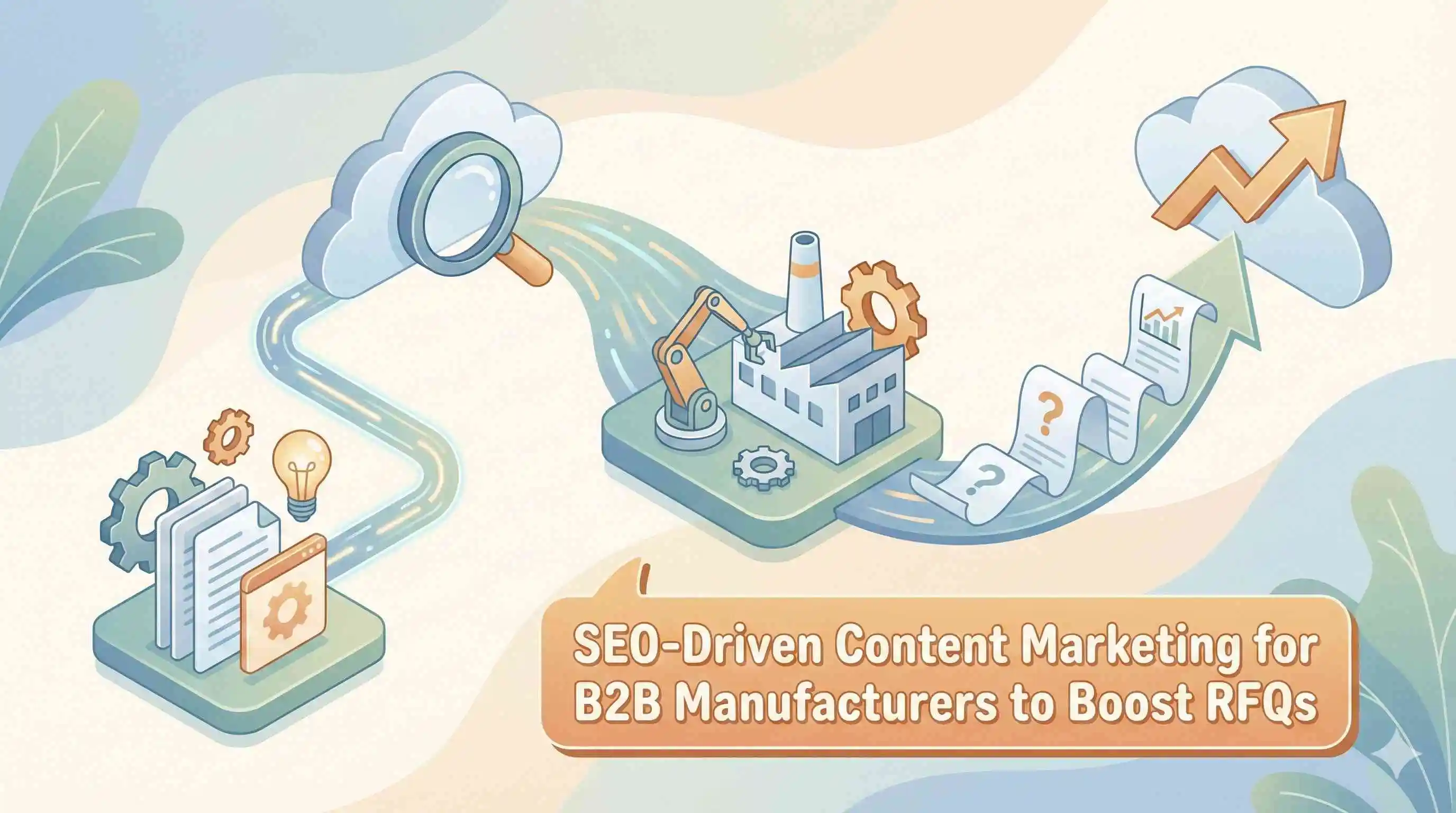
Manufacturing SEO: 3x Your RFQs in 2026 (Proven Guide)
B2B manufacturers: triple your RFQs with SEO. Learn how to rank for industrial keywords and turn website traffic into qualified leads.


Imagine pouring budget into content that looks great but never translates into real sales conversations or RFQs. You’ve got the polished case studies and the detailed spec sheets, but the phone isn’t ringing with qualified leads. You’re not alone. Most manufacturing companies are stuck in a cycle of creating static, product-centric “brochureware” that fails to rank on search engines, ignores how modern B2B buyers research, and does nothing to compel a prospect to request a quote.
This guide is different. We’re cutting through the noise. From one founder to another, I’ll show you how to build an SEO-optimized “hero content” engine that does one job exceptionally well: establishing your authority so thoroughly that qualified buyers are compelled to contact you for a quote. Let’s move beyond vanity metrics and build a system that reliably fills your sales pipeline.
Redefining 'Hero Content' for the Manufacturing Floor
For decades, manufacturing marketing meant catalogues, spec sheets, and “capabilities” PDFs. This is brochureware, and for today’s B2B buyer, it’s a dead end. Engineers, plant managers, and procurement specialists don’t start their journey by looking at your product list. They start with a problem: “How do I reduce vibration in this assembly?” or “What’s the most cost-effective finishing for a high-wear component?”
Hero content is the antithesis of brochureware. It’s not about you; it’s about your customer’s deepest challenges. Its core components are:
-
Authority: It demonstrates deep, proven expertise.
-
Relevance: It directly addresses the specific problems your ideal buyer is searching for.
-
Conversion Focus: It’s designed to build trust to the point where an RFQ is the logical next step.
This content aligns perfectly with the long, technical, and risk-averse B2B manufacturing buyer’s journey. A procurement officer isn’t buying a lathe; they’re buying confidence in your ability to deliver precision parts on time, every time. Hero content sells that confidence.
From Spec Sheets to Storytelling
Transform your technical data into a narrative. Instead of listing the tolerances of your CNC machines, tell the story of how you helped a medical device manufacturer solve a critical tolerance issue that was causing product failures.
The Framework:
-
The Problem: Start with the client’s acute pain point. “Acme Medical was experiencing a 15% failure rate due to inconsistent bore diameters in a titanium housing.”
-
The Process: Detail your diagnostic approach. “We conducted a gage R&R study and found thermal instability in their previous supplier’s process.”
-
The Solution: Explain your specific, technical solution. “We implemented a temperature-controlled machining cell and used in-process laser measurement for real-time feedback.”
-
The Result: Quantify the outcome. “Failure rate dropped to 0.2%, and annual scrap costs were reduced by $320,000.”
This format transforms dry specs into a compelling proof of problem-solving ability.
Case Studies: The Ultimate Hero Content
A well-structured case study is your most powerful RFQ generation tool. It’s the ultimate “show, don’t tell” asset.
Structure of a High-Converting Manufacturing Case Study:
-
Client & Challenge: Name the client (with permission) and detail their specific, relatable challenge.
-
Technical Requirements: List the precise specs materials, tolerances, volumes, regulatory standards.
-
Your Solution & Process: This is the hero section. Detail your workflow, technology used, quality checks, and project management. Use photos, diagrams, or videos.
-
Quantifiable Results: Lead with hard numbers: cost savings, throughput increase, scrap reduction, efficiency gains.
-
Client Testimonial: A direct quote adds immense third-party credibility.
-
Strategic CTA: End with “Facing a similar challenge? Request a feasibility review for your project.”
The SEO Gap in Traditional Industrial Marketing
You can create the world’s best content, but if no one can find it, it’s worthless. Most manufacturing websites make critical SEO mistakes that bury their expertise.
Common SEO Mistakes:
-
Keyword Stuffing: Forcing “precision CNC machining” into sentences unnaturally.
-
Ignoring User Intent: Creating a page for “aluminum parts” when the searcher wants “how to design for aluminum die casting.”
-
Thin Content: Pages with only 200 words of text and a giant PDF download.
-
Neglecting Technical SEO: Slow-loading pages choked with unoptimized images of machinery and CAD files.
The phrase “manufacturer near me” is a low-intent search. The high-intent buyer is already deeper in their journey, searching for solutions like “hardened steel vs. carbide for wear resistance” or “GD&T best practices for complex assemblies.” These commercial investigation keywords are your golden ticket. Ignoring SEO means invisibility to the engineers and specifiers actively building their vendor shortlists.
Keyword Intent: Beyond 'Manufacturer Near Me'
To capture buyers before they request quotes, you must target keywords that map to their research phase.
| Intent Stage | Keyword Example | Content Type to Create |
|---|---|---|
| Informational | “What causes stress corrosion cracking in stainless steel?” | In-depth blog post or guide. |
| Commercial Investigation | “5-axis vs. 3-axis CNC machining for aerospace components” | Comparison whitepaper or detailed article. |
| Transactional | “ISO 9001:2015 certified CNC machining RFQ” | Services page optimized for conversion. |
Your goal is to own the informational and commercial investigation conversations. The company that provides the best answer to “how do I solve this engineering problem?” becomes the trusted authority who gets the RFQ.
Technical SEO for Heavy Assets
Manufacturing websites are uniquely challenging: they’re full of heavy images, technical drawings, and large files. Here’s how to fix it:
-
Image Optimization: A 10MB image of your factory floor will kill page speed. Use modern formats (WebP), compress aggressively, and implement lazy loading.
-
CAD & Diagram Files: Don’t just offer a direct download. Create a dedicated webpage for the file with descriptive text, explain its applications, and embed a preview image. This gives Google context to rank the page.
-
Core Web Vitals: Use tools like Google PageSpeed Insights. Prioritize fixing issues like Cumulative Layout Shift (CLS) nothing erodes trust like a page that jumps around as an engineer tries to click a technical diagram.
-
Schema Markup: Implement
HowToschema for your process guides,Productschema for your capabilities, andOrganizationschema with your certifications. This helps search engines understand your content and can generate rich results.
Blueprint: Building SEO-Optimized Hero Content
Creating hero content isn’t a one-off project; it’s a systematic process. Here’s a founder’s blueprint.
Step-by-Step Process:
-
Keyword & Question Discovery: Use tools (Ahrefs, SEMrush, AnswerThePublic) to find what your audience is asking. Interview your sales team for common prospect questions.
-
Cluster Planning: Group these questions into thematic clusters.
-
Pillar Creation: Write a comprehensive, long-form pillar page that provides a broad overview of the core topic.
-
Cluster Content Creation: Write detailed articles (cluster content) that answer each specific question, all linking back to the pillar page.
-
Publication & Promotion: Launch, then actively promote to relevant engineering communities, LinkedIn groups, and via email newsletters.
In manufacturing, long-form, detailed content consistently outperforms thin pages. A 2,000-word guide on “Design for Manufacturability for Injection Molding” signals to both readers and Google that you are a serious source of expertise. Integrate primary data from your projects, quote your lead engineers, and use original diagrams.
The Topic Cluster Model for Manufacturing
Let’s take “Precision CNC Machining” as a core service pillar.
-
Pillar Page: “The Ultimate Guide to Precision CNC Machining.” This is a comprehensive, high-level resource.
-
Cluster Content (Linking to the Pillar):
-
Blog Post: “CNC Milling vs. Turning: How to Choose.”
-
Guide: “Understanding Surface Finish Standards (Ra, Rz) for CNC Parts.”
-
Article: “How to Optimize CAD Models for 5-Axis Machining.”
-
Case Study: “Achieving Micron-Level Tolerances for a Optical Mount.”
-
This structure creates a content ecosystem that dominates the topic, improves your site’s SEO architecture, and guides users deeper into your expertise.
Long-Form Content That Engineers Love
The anatomy of a high-performing, in-depth guide:
-
Definitive Introduction: State the problem and what the reader will learn.
-
Logical, Hierarchical Structure: Use clear H2s and H3s.
-
Technical Depth: Don’t shy away from details. Explain the why behind recommendations.
-
Data Visualization: Include tables comparing materials, charts showing tolerance vs. cost curves, or flowcharts of your quality process.
-
Actionable Takeaways: End each section with a clear, practical tip they can apply.
-
Further Resources: Link to your relevant cluster content and tools.
Visuals and Data: Showing, Not Telling
A complex manufacturing process is best explained visually. Instead of three paragraphs describing your quality inspection workflow, use a simple flowchart created in Lucidchart or draw.io.
[Client Part Received] → [3D Scan & Dimensional Analysis] → [Data vs. CAD Model] → [Pass/Fail Report Generated] → [Report Sent to Client]
Include annotated infographics that break down a complex assembly you manufactured. Photos of your team solving problems on the shop floor are more authentic than sterile stock images. These visuals increase engagement, dwell time (a positive SEO signal), and comprehension.
From Clicks to RFQs: The Conversion Pathway
Great content attracts visitors; a great conversion pathway turns them into leads. You must map your content to the sales funnel and design intentional pathways to an RFQ.
- Awareness Stage (Top of Funnel): Content: Blog posts, infographics. Goal: Educate and attract.
- Consideration Stage (Middle of Funnel): Content: Case studies, comparison guides, whitepapers. Goal: Build trust and demonstrate superiority.
- Decision Stage (Bottom of Funnel): Content: ROI calculators, consultation offers, detailed capability overviews. Goal: Trigger the RFQ.
Your calls-to-action (CTAs) must match the content’s context. A visitor reading a deep technical guide is not ready to “Contact Sales.” They are, however, ready for the next logical step in their education.
Strategic CTAs in Technical Content
Example 1: Within a guide on “Preventing Galling in Stainless Steel Fasteners,” include a CTA like: “Download our full Material Compatibility Guide for High-Stress Applications” (which is a gated PDF).
Example 2: At the end of a detailed case study on a complex project, use: “Schedule a 30-minute manufacturing feasibility review for your custom component.”
These CTAs feel like a natural extension of the helpful content, not a sales interruption.
Nurturing Leads with Gated Content
Your gated content must be valuable enough to warrant an exchange of contact information. Think like an engineer:
-
Valuable: A proprietary CAD library of common fixture designs.
-
Useful: An interactive “Tolerance vs. Cost Calculator” for machined parts.
-
Authoritative: A primary research report on “The State of Additive Manufacturing in Aerospace.”
When someone downloads this, they’ve raised their hand. Now, use an automated email sequence to nurture them:
-
Email 1: Deliver the asset and reinforce its value.
-
Email 2: Share a relevant case study that shows the asset’s principles in action.
-
Email 3: Offer a low-pressure next step: “Have questions about applying this to your project? Reply to this email for a quick chat with our lead engineer.”
This process qualifies the lead and warms them up for the sales team, making the eventual RFQ conversation much more productive.
Measuring What Matters: Beyond Vanity Metrics
Forget pageviews and social shares. In B2B manufacturing, your content marketing ROI is measured in RFQs and closed deals.
Key Performance Indicators (KPIs):
-
RFQ Volume: Raw number of quote requests.
-
Cost Per Lead (CPL): Total content marketing spend / number of marketing-qualified leads.
-
Deal Velocity: Does content-nurtured leads move through the sales cycle faster?
-
Content Attribution: What percentage of RFQs interacted with content before submitting?
Set up tracking from day one. Use UTM parameters on every link you share. Use form tracking on your “Contact Us” and “Request a Quote” pages to see the prior page the visitor was on. Integrate your website analytics with your CRM to see the full journey from first blog visit to closed won deal.
Tracking RFQ Attribution
A simple yet powerful method:
-
In conversion tracking tools, set up an “RFQ Submission” event.
-
Use the “Journey” exploration report to see the sequence of pages/users viewed before submitting the event.
-
Tag all your content promotion links (social, email, forums) with UTM parameters (e.g.,
utm_source=linkedin&utm_medium=social&utm_campaign=cnc_guide_promo). -
In your CRM, create a field for “Lead Source Detail” where sales can note if the prospect mentions a specific piece of content.
This data is gold. It tells you which hero content pieces are actual business drivers.
A/B Testing Your Hero Content
You don’t need complex software to start. Test one variable at a time:
-
Headline Test: Promote the same case study with two different headlines on LinkedIn: “How We Saved Acme $300k in Scrap” vs. “Solving Tolerance Stack-Up in Medical Device Manufacturing.”
-
CTA Test: On the same guide, test two button colors or two different CTA texts (“Download Guide” vs. “Get Your Copy”).
-
Format Test: For the same topic, create one long-form article and one 5-minute video summary. See which generates more engagement and downstream leads.
Use the winner as your new benchmark and keep iterating.
Conclusion
Generating consistent RFQs in the competitive B2B manufacturing space requires a fundamental shift. It demands moving from static, self-centered brochureware to creating authoritative, deeply helpful, and SEO-optimized hero content. This content answers your prospect’s most pressing technical questions long before they’re ready to buy, building the trust and credibility that makes requesting your quote the obvious, low-risk choice.
It’s a system: target the right search intent, build comprehensive topic clusters, guide visitors with strategic CTAs, and measure everything against real business outcomes. The companies that embrace this are the ones that will be found, trusted, and chosen.
Ready to build your hero content engine? It starts with a clear audit of your current assets. Download our free ‘Manufacturing Hero Content Audit Worksheet’ to systematically assess your existing content, identify gaps, and plan your first high-impact piece designed to generate real RFQs.
Thanks for reading! ❤️
Written by
JenishRead Next



Turn this into your AI Search strategy
LLaMaRush creates SEO, AEO, and GEO optimized content built to rank in Google and get cited by AI answer engines.
Start Ranking Everywhere