
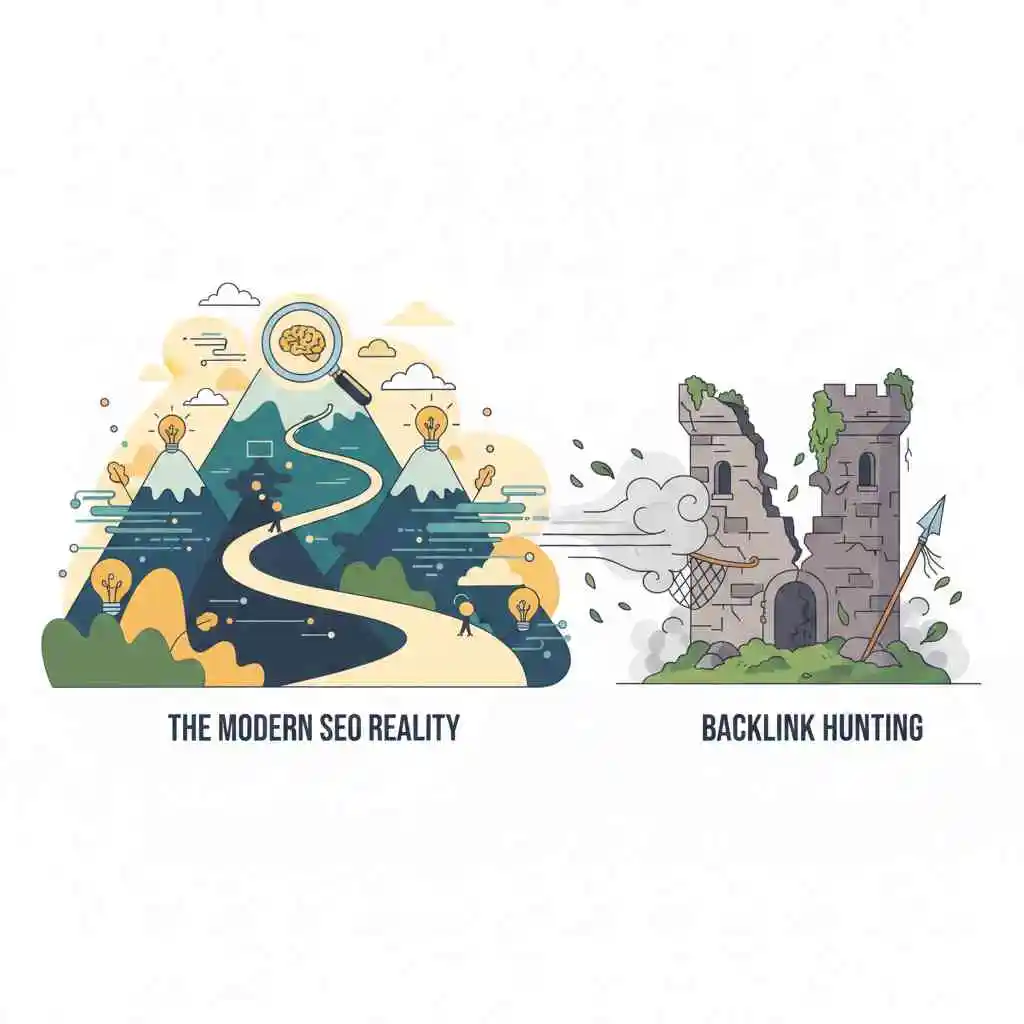
Topical Authority vs Backlinks: What Actually Ranks in 2026?
The Backlink Obsession Trap
Let me start with a controversial statement: if you're still spending more time building backlinks than building topical authority, you're playing 2015's SEO game in 2025's reality.
I know this goes against everything you've heard. The SEO industry has spent two decades preaching "backlinks are king." Entire businesses were built on link building. Agencies charge thousands per month for "link outreach."
But here's what they're not telling you: Google's algorithms have evolved past simple link counting. The search engine that once needed links to understand authority now uses artificial intelligence, entity recognition, and topic modeling to answer a more important question:
"Does this website actually know what it's talking about?"
In this guide, I'll show you why topical authority now matters more than backlinks, how to build it systematically, and why this shift is the best thing that's ever happened for bootstrapped founders and indie makers.
Part 1: The Algorithmic Shift That Changed Everything
From Link Graphs to Knowledge Graphs
2010-2015: The Link Era
Google's algorithm was relatively simple:
- Find pages with keywords
- Count backlinks as "votes"
- Rank pages by vote count
- Adjust for some basic quality signals
In this world, you could rank with mediocre content if you had great links.
2020-2025: The Understanding Era
Google now uses:
- BERT/MUM to understand context and nuance
- Knowledge Graph to map relationships between entities
- Topical Authority Models to assess comprehensive expertise
- E-E-A-T frameworks to evaluate real-world credibility
Today, you need to demonstrate comprehensive understanding of topics, not just collect endorsements (links).
The Evidence: Google's Own Moves
- Penguin Updates (2012-2016): Began devaluing manipulative links
- BERT (2019): Started understanding content context, not just keywords
- Helpful Content Update (2022): Explicitly rewards comprehensive, helpful content
- Product Reviews Updates (2021-2023): Rewards hands-on experience over affiliate links
The pattern is clear: Google increasingly trusts what you know over who you know.
Part 2: What Topical Authority Actually Is (And Isn't)
The Official Definition:
Topical authority is Google's assessment of your website as a comprehensive, trustworthy source on a specific topic or cluster of related topics.
The Practical Definition:
When you've covered a topic so thoroughly that:
- Google sends you all related queries, not just your target keywords
- Users trust your answers over competitors'
- Other sites cite you as a source naturally
- You rank for long-tail variations you never specifically targeted
What It's NOT:
- Not just publishing lots of content (It does help when quality is really good)
- Not keyword stuffing
- Not superficial coverage
- Not ranking for one main keyword
What It IS:
- Depth over breadth
- Clusters over individual pages
- Understanding over mentioning
- Comprehensiveness over quick wins
Part 3: Why Topical Authority Beats Backlinks in 2025
Reason 1: Link Quality Has Collapsed
- Guest posting networks are largely devalued
- Directory links have minimal impact
- Paid links risk penalties
- Forum/profile links are often nofollowed
- What remains: genuine editorial links, which are earned through... topical authority
Reason 2: AI Content Flooded the Link Market
With AI tools generating content at scale:
- Low-quality link building is cheaper than ever
- Google can't trust links as quality signals alone
- The solution: rewarding actual expertise instead
Reason 3: Google Understands Topics, Not Just Pages
Modern Google:
- Maps how topics connect
- Understands subtopic relationships
- Recognizes content gaps
- Rewards topic completion
Example: If you write about "email marketing," Google expects you to also cover:
- Email deliverability
- Open rate optimization
- Subject line writing
- List segmentation
- CAN-SPAM compliance
- Automation workflows
- Analytics tracking
Missing these? You won't be seen as authoritative.
Reason 4: User Behavior Signals Are Stronger
When you have topical authority:
- Lower bounce rates (users find what they need)
- Longer dwell times (they read multiple articles)
- More return visits (you become their go-to source)
- Higher engagement (comments, shares, saves)
These signals directly impact rankings—often more than additional backlinks.
Reason 5: It Creates Sustainable Competitive Moats
A competitor can:
- Outspend you on links
- Hire better writers
- Build a prettier site
But they cannot quickly replicate:
- Your comprehensive coverage
- Your interconnected content clusters
- Your years of accumulated topic depth
- Your recognized expertise
Part 4: The Topical Authority Framework (TAF)
Phase 1: Foundation Mapping
Step 1: Define Your Core Topic
Not "marketing" or "SaaS", be specific:
- Too broad: "Project management"
- Better: "Agile project management for remote teams"
- Best: "Scrum implementation for distributed tech teams"
Step 2: Map the Topic Universe
Identify all related subtopics:
- Core concepts: Scrum, sprints, retrospectives
- Related tools: Jira, Trello, Asana comparisons
- Common problems: Time zone challenges, async communication
- Advanced topics: Scaling scrum, hybrid methodologies
Tool note: Platforms like LLaMaRush excel here, our AI can analyze topic clusters and identify gaps most humans miss, creating a content plan based on that and write long content accordingly.
Step 3: Audit Your Existing Coverage
For each subtopic, assess:
- Covered? (Yes/No)
- Depth? (Surface vs. comprehensive)
- Freshness? (Updated in last 12 months?)
- Performance? (Traffic, rankings, engagement)
Phase 2: Content Architecture
The Hub-and-Spoke Model
                     [Core Topic Hub]
                    /       |        \
              [Subtopic] [Subtopic] [Subtopic]
                /   \      /   \      /   \
        [Related] [Related] [Related] [Related]
Hub Page: Comprehensive guide (3,000+ words)
Spoke Pages: Individual subtopic deep dives (1,500+ words each)
Connections: All pages interlink based on relevance
Content Depth Standards
Tier 1: Ultimate Guides (3,000-5,000 words)
- Complete topic coverage
- Actionable frameworks
- Templates/resources
- Expert interviews
Tier 2: Deep Dives (1,500-3,000 words)
- Specific aspect coverage
- Step-by-step instructions
- Case studies/examples
- Data/statistics
Tier 3: Supporting Content (800-1,500 words)
- How-to articles
- Comparison pieces
- Problem/solution content
- Definition/explainer posts
Phase 3: Implementation Strategy
The 70/20/10 Rule
- 70% of effort: Deepening existing topic clusters
- 20% of effort: Creating new spoke content
- 10% of effort: Experimental/new topic testing
The Content Sequencing Matrix
Quarter 1: Foundational Coverage
- 1 hub page
- 5-7 core spoke pages
- Basic interlinking

Quarter 2: Depth Expansion
- Update hub with new insights
- Add 10-12 secondary spoke pages
- Begin FAQ/supporting content

Quarter 3: Authority Building
- Add original research/data
- Include expert perspectives
- Expand to related topics

Quarter 4: Maintenance & Growth
- Update/refresh existing content
- Fill remaining gaps
- Monitor/tweak based on performance
Phase 4: Quality Signals
Demonstrating E-E-A-T Through Content
Experience:
- Case studies with real results
- "Lessons learned" sections
- Behind-the-scenes insights
Expertise:
- Technical depth without jargon
- Citations to reputable sources
- Original frameworks/models
Authoritativeness:
- Being cited by other experts
- Conference/webinar presentations
- Industry recognition
Trustworthiness:
- Transparent methodology
- Balanced perspectives (pros/cons)
- Error correction policies
Part 5: Measuring Topical Authority Success
Traditional Metrics (What Everyone Measures)
- Keyword rankings
- Organic traffic
- Backlink count
Topical Authority Metrics (What Actually Matters)
Metric 1: Topic Cluster Performance
- Coverage percentage: % of subtopics covered
- Average position across all cluster keywords
- Impression share for your topic space
Metric 2: User Trust Signals
- Return visitor rate for topic pages
- Cross-topic navigation: Users moving between related articles
- Time spent per topic cluster (not just per page)
Metric 3: Algorithmic Recognition
- Featured snippet capture rate
- "People Also Ask" appearances
- Knowledge panel inclusion (when relevant)
Metric 4: Competitive Authority
- Share of voice in your topic space
- Citation rate by competitors/industry sites
- Branded search growth for topic-related terms
The Authority Scorecard
Rate your site monthly:
- Coverage: Are we missing any critical subtopics?
- Depth: Is our content truly comprehensive?
- Freshness: Is everything up-to-date?
- Integration: Are topics properly connected?
- Performance: Are we dominating our space?
Part 6: Common Pitfalls (And How to Avoid Them)
Pitfall 1: Topic Hopping
Mistake: Covering too many unrelated topics
Solution: The "80/20 Rule" - 80% of content in core topics, 20% exploration
Pitfall 2: Surface-Level Coverage
Mistake: Writing 50 articles at 800 words each
Solution: Write 20 articles at 2,000+ words with real depth
Pitfall 3: Ignoring Content Decay
Mistake: Publishing and forgetting
Solution: Quarterly content audits and updates
Pitfall 4: Poor Internal Linking
Mistake: Articles existing in isolation
Solution: Strategic interlinking based on topic relationships
Pitfall 5: Chasing Trends Over Fundamentals
Mistake: Writing about every new tool/trend
Solution: Focus on evergreen fundamentals first
Part 7: The Backlink Connection (They Still Matter, Differently)
The New Role of Backlinks
Backlinks are now:
- Confirmation of authority, not creation of authority
- Result of great content, not replacement for great content
- Amplifier of existing rankings, not creator of rankings
How Topical Authority Earns Better Links
When you become the authoritative source:
- Natural citations increase (people link to experts)
- Resource page links flow (you're included in "best resources" lists)
- Journalists reach out (for quotes/expert commentary)
- Academic citations happen (for data/research)
The Quality-Quantity Shift
Old approach: Get 100 links from anywhere New approach: Get 10 links from true authorities in your field
Part 8: The Competitive Advantage for Bootstrapped Founders
Why This Levels the Playing Field
Large companies can:
- Outspend you on link building
- Hire SEO agencies
- Buy existing sites
But they cannot:
- Fake genuine expertise quickly
- Replicate years of focused topic coverage
- Manufacture authentic user trust
The Founder's Advantage
You have:
- Real experience solving real problems
- Deep niche understanding
- Authentic voice and perspective
- Genuine customer insights
These are the exact ingredients topical authority rewards.
Resource Allocation Shift
Instead of spending:
- 70% on link building
- 20% on content
- 10% on technical SEO
Now spend:
- 60% on authoritative content creation
- 20% on content promotion (not link begging)
- 15% on technical excellence
- 5% on strategic relationship building
Part 9: Implementation Roadmap
Month 1-3: Foundation
- Define your core topic
- Map the topic universe
- Audit existing content
- Create content plan
- Publish hub page + 3 spoke pieces
Month 4-6: Expansion
- Fill major content gaps
- Interlink everything
- Begin original research
- Update existing content
- Monitor topic cluster performance
Month 7-9: Authority
- Add advanced/expert content
- Seek genuine partnerships
- Expand to related topics
- Build supporting resources
- Establish update processes
Month 10-12: Dominance
- Own your topic space
- Become go-to source
- Scale what works
- Defend your position
- Plan next topic cluster
Part 10: Tools That Actually Help
For Topic Mapping:
- Ahrefs/SEMrush for keyword research
- AlsoAsked for question discovery
- Mind mapping tools for visualization
For Content Planning:
- Notion/Airtable for content calendars
- Google Sheets for tracking coverage
- LLaMaRush for automated content planning
For Authority Monitoring:
- Google Search Console for performance data
- Google Analytics for user behavior
- BuzzSumo for content analysis
Advanced Insight:
Some AI-powered platforms now specialize in topical authority development. For example, LLaMaRush can automatically analyze your entire site, identify topical gaps with surgical precision, and suggest content that fills those gaps while strengthening your overall authority profile, essentially providing improvement roadmap.
Conclusion: The Mindset Shift That Changes Everything
The transition from backlink-focused SEO to topical authority isn't just a tactical change, it's a philosophical shift.
Old Mindset:
"I need more links to rank."
New Mindset:
"I need to know this topic better than anyone else, then demonstrate that knowledge comprehensively."
The Beautiful Result:
When you focus on topical authority:
- SEO becomes sustainable (not susceptible to algorithm updates)
- Traffic becomes predictable (steady growth from topic dominance)
- Conversion rates improve (trusted experts convert better)
- Competition becomes irrelevant (you own your niche)
Your Starting Point Today:
- Pick one topic where you can be the world's best resource
- Map every subtopic you need to cover
- Create one comprehensive piece this week
- Plan the next five pieces to build around it
- Commit to owning this topic over the next 12 months
The Ultimate Truth:
In a world of AI-generated content and manipulative SEO tactics, genuine expertise demonstrated through comprehensive coverage is becoming the scarcest, most valuable resource on the internet.
Google isn't just rewarding it because it's "nice", they're rewarding it because it's the only reliable signal left in an increasingly noisy digital world.
Your knowledge, your experience, your unique perspective, these are your competitive advantages. Not your backlink profile. Not your domain authority. Not your technical optimizations.
Become the authority, and the rankings will follow.
Build the resource, and the links will come.
Serve your audience completely, and Google will have no choice but to send everyone your way.
Start building your topical authority today. It's the only SEO strategy that gets more valuable with time, more resistant to competition, and more aligned with what both users and search engines actually want.
Founder-Friendly Summary:
- Stop chasing links. Start building knowledge.
- Your expertise is your moat. Your content is your proof.
- Depth beats breadth. Authority beats optimization.
- Own a topic completely, and you own the traffic that comes with it.
Thanks for reading! ❤️
Read Next


Stop guessing your SEO strategy
LLaMaRush gives you data-driven content plans and automated insights to rank higher, faster.
Start Ranking Today