
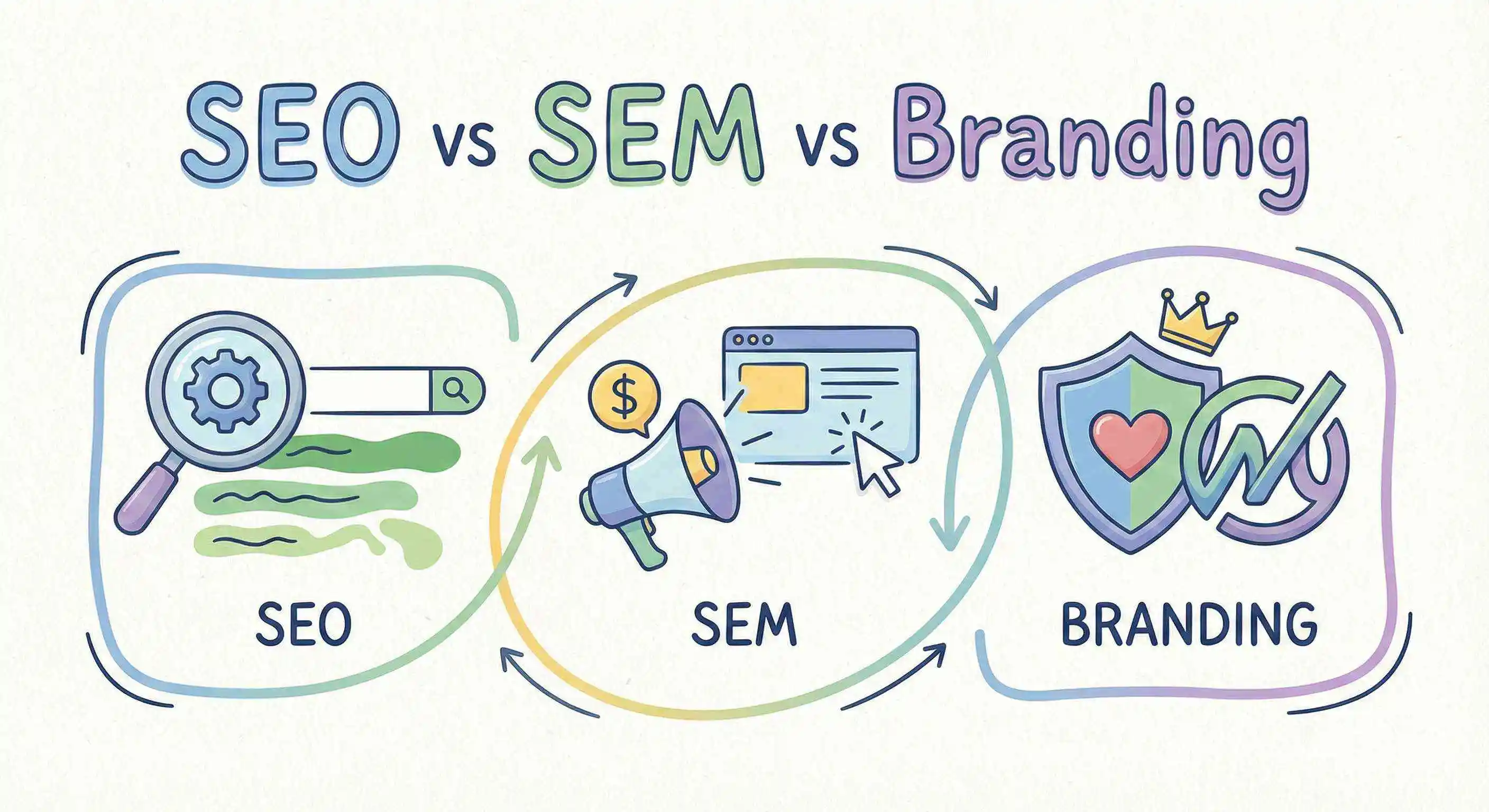
SEO vs SEM vs Branding: Which Grows Your Startup Faster?
As a startup founder, you want growth but have limited time and budget. You’ve likely heard of SEO (search engine optimization), SEM (search engine marketing or paid search), and the importance of branding. But what do these terms really mean, and how do they differ in driving traffic and sales? In this guide, we break down each approach in plain language (no jargon!), explain how they fit together, and help you decide where to focus your efforts.
Think of it this way: SEO and SEM are both ways to get found in search engines, but SEO is the long-term, organic strategy while SEM (often just paid ads) is a quick-injection booster. Branding is a broader concept, it’s building trust and recognition so people remember and prefer you. We’ll show how each strategy works, their pros and cons, and how they can complement each other on your growth journey.
What is SEO?
SEO (Search Engine Optimization) is the process of improving your website so that it ranks higher in organic (unpaid) search results. In practice this means creating high-quality, keyword-focused content, optimizing your site’s technical health, and earning links or mentions from other sites. Your goal is to have Google (and other search engines) see your site as the most relevant answer for people’s queries.
SEO is essentially a long-term play. It doesn’t bring instant traffic, but once you rank well, the traffic you get is effectively “free.” For example, studies show organic search accounts for over 50% of website traffic on average. Users also trust organic results more than ads, the top organic spots get clicked ~19× more often than paid ads. In other words, if you manage to rank on page 1, every click is a win without having to pay per click. And that traffic often continues for months or years from a single piece of content.
Perhaps unsurprisingly, this trust translates into big ROI. One analysis found that a well-executed SEO strategy can yield around 748% ROI over three years, far outpacing paid search’s 36%. In practical terms: the content and links you build today will keep paying dividends well into the future.
Drawbacks: The trade-off is time and effort. SEO requires patience and consistency. It often takes many months to see real gains. For example, new sites often need 6–12 months or more of steady content and optimization before ranking well. (One study noted it can take about 2 years on average to reach Google’s first page.) You’ll need to regularly add content, tweak page elements (titles, meta tags, speed, etc.), and build some backlinks. Also, Google’s algorithm changes and competition for keywords can make SEO a moving target. But if you stick with it, your site becomes a lasting resource that funnels traffic 24/7, even when you sleep.
Key takeaway: SEO = long-term organic traffic. It builds credibility and trust, costs mostly time & effort, and compounds growth. Tools like LLaMaRush can make this easier by automating many SEO tasks. For example, LLaMaRush connects your Google Analytics and Search Console, highlights your top keyword opportunities, and even generates a content publishing plan with content which actually ranks well. This “AI co-founder” workflow (Connect → Analyze → Plan → Publish → Grow) keeps your SEO engine running without guesswork.
What is SEM?
SEM (Search Engine Marketing) typically refers to paid search advertising (e.g. Google Ads, Bing Ads). Unlike SEO’s free clicks, SEM means you bid on keywords and pay each time someone clicks your ad. In exchange, you can place your listing at the very top of search results immediately. As one SEO analysis puts it, SEM “offers something completely different with its speed”, your ads can reach the top positions just hours after your campaign starts. This makes SEM perfect for short-term goals: launching a product, promoting a time-limited offer, or quickly validating an idea. You’ll immediately capture people with high purchase intent (they’re searching for something you sell right now).
SEM gives you granular control. You can target based on location, device, time of day, and set your budget. It’s very measurable, you see exactly how much each click or conversion costs. However, the moment you stop paying, the traffic stops, too. Think of SEM like renting prime retail space. You pay rent (ad spend) to stay visible. Once you quit, you lose that top spot to competitors and drop off the map.
Drawbacks: SEM can get expensive, especially in competitive niches. Some keywords cost $50+ per click (or more!), and small budgets run out fast. Also, many savvy searchers ignore ads or scroll past them. Studies show that paid ads get significantly fewer clicks than organic listings. In other words, your conversion rate from ads may be lower. Lastly, managing SEM well requires ongoing work (monitoring bids, optimizing ads and landing pages). Mistakes can waste budget.
Key takeaway: SEM = short-term paid traffic. It buys you instant visibility and is great for quick campaigns or tests. But it requires continuous spend, and its effects vanish when you stop paying. Use SEM when speed is essential (e.g. a product launch or urgent traffic goal), and when you can closely track and optimize ROI.
What is Branding?
Branding is about building your company’s identity, reputation, and trust in the eyes of your audience. It’s not a tactic that shows up immediately in Google, but it shapes everything else you do. At the simplest level, your brand is what makes you recognizable: your name, logo, messaging, values, and story. A strong brand makes people feel something, familiarity, trust, even love, which can drive them to choose you over unknown competitors.
Why does branding matter for growth?
For one, people naturally click on brands they know. A well-known brand signals quality or reliability. Studies back this up: 59% of searchers will click on a result for a brand they recognize, and 81% of consumers only consider buying from a brand they trust. This means that if you’ve built even a little brand awareness, your search (and ad) results get more clicks.
Branding also interacts with SEO/SEM. Search engines (and new AI-driven systems) increasingly factor brand signals into rankings. For example, a trusted brand tends to earn more backlinks (since people cite well-known sources) and gets more repeat organic searches by name. Bruce Clay notes that a strong brand “creates trust, a key factor that can boost your search engine visibility and drive organic traffic and conversions”. In other words, brand equity is an SEO asset.
Unlike SEO and SEM, branding is purely long-game. It requires consistent messaging and presence over time. Kantar nicely summarizes it: “Branding is all about the long-term goals and identity of a company... Branding is the overarching way you appear to the world. It is consistent and unchanging”. Marketing campaigns (SEO content or ads) can change often, but your brand should remain solid. A strong brand builds an emotional relationship with customers, not just a need for a one-time sale.
Key takeaway: Branding = long-term identity and trust. It doesn’t directly produce immediate clicks like SEO/SEM, but it underpins all your marketing. A well-recognized brand increases click-throughs and conversion rates across the board. For founders, focus on clear values and messaging (even if it’s just on your website or social media) so that when people do find you through search or word-of-mouth, they have a positive connection. Over time, brand strength can also justify premium pricing and loyalty.
Key Differences: SEO vs SEM vs Branding
Let’s compare the three strategies side by side:
Timeframe:
-
SEM: Immediate. Ads can get you to the top of search within hours. Traffic starts as soon as you launch campaigns.
-
SEO: Slow. It often takes months (6–12+) of effort to rank high organically. It’s a marathon, not a sprint.
-
Branding: Very long-term. Building trust and awareness happens over years. You won’t see overnight results; instead, you steadily grow recognition over time.
Cost:
-
SEO: Mostly your time and possibly modest tool subscriptions. You pay for content creation and maybe an SEO tool (or your own effort). Once content ranks, clicks are “free.”
-
SEM: Direct ad spend per click (often hefty). Costs can range from hundreds to thousands per month. You pay for every visitor.
-
Branding: Can vary. Some branding (good design, clear messaging) can be done cheaply; other parts (PR, sponsorships, creative campaigns) cost money. But it’s an ongoing investment rather than a per-click cost.
Return on Investment (ROI):
-
SEO: Tends to be very high in the long run. Content continues to attract traffic at almost zero incremental cost. For example, one study reported ~748% ROI over 3 years for SEO vs 36% for SEM.
-
SEM: ROI is immediate but lower. You might get quick leads, but the lifetime value of that traffic must cover your ad spend. It’s often short-lived, as soon as spending stops, ROI drops to zero.
-
Branding: Hard to quantify directly. It’s an “intangible” return that shows up as higher conversions, pricing power, and customer loyalty over the long haul. Think of it as multiplying effect on all your other channels.
Trust & Click-Through:
-
SEO: Organic results are trusted. ~19× more clicks go to top organic results compared to paid ads. If your site ranks well, users often assume you’re the authoritative choice.
-
SEM: Ads have lower trust/CTR. A large fraction of users skip ads entirely. You may get volume but often lower conversion per visitor.
-
Branding: A strong brand dramatically boosts trust and click-through. People readily click on names they recognize. If your brand is known, even an organic result without ads will perform better than an unknown site’s result.
Best Use-Cases:
-
SEO: Great for content-heavy, scalable growth. If you have valuable knowledge, guides, blog posts, or product pages that answer questions, SEO compounds over time. It suits startups with long runway who want steady inbound leads without recurring ad costs.
-
SEM: Ideal for short-term needs and high-intent targets. Think product launches, special promotions, job postings, or any case where you need immediate visibility. Also useful for testing which keywords convert, you can try ads first, then invest in SEO for winners.
-
Branding: Crucial for differentiation and loyalty. If you’re in a crowded market, branding helps you stand out and justifies premium pricing. Also important if your purchase cycle is long or trust-based (e.g. healthcare, finance, SaaS). Even for startups, starting brand-building early pays off later.
When to Use Each Strategy
As a practical rule, startups often use all three in different proportions. Here are some guidelines:
-
Early Stage / Pre-Launch: Focus on branding and initial SEO content. Spend time defining your brand voice and values (they guide everything). Begin publishing some SEO-optimized content (e.g. FAQ, blog posts) to start accumulating web presence. If you have a product or MVP, run a small SEM test campaign to validate demand, for example, use ads to a landing page to see if people click and convert.
-
Launch / Short Term Push: Lean on SEM for quick traffic. For example, launch an ad campaign around your opening or a new feature. At the same time, keep adding SEO content in the background and continue nurturing your brand on social media or through partnerships.
-
Growing / Mid-Term: Now your SEO efforts should start paying off. Continue creating useful content and building links. Use SEM strategically (for specific campaigns or keywords you’re not yet ranking for). Branding continues, consider email newsletters, PR, or community engagement to keep your name out there.
-
Established Growth: SEO should be carrying a large part of your traffic. You can gradually taper SEM spend as organic visibility rises. But keep SEM around for competitive keywords and new initiatives. Branding should now be well-defined: maintain consistency across all channels (website, social, ads, PR).
Throughout, measure and adjust. Track organic traffic growth (SEO), cost-per-lead (SEM), and any brand metrics you can (surveys, brand search volume, or even direct “Are you aware of X company?”). Over time, you might find an optimal mix, for instance, start with 70% SEO/30% SEM, then shift to 90% SEO as organic gains steam.
In practice, many companies use a hybrid approach. For example, an ecommerce startup might:
-
Use SEM to get sales during holiday season (fast, high return potential)
-
Invest in SEO year-round by blogging product guides (steady traffic, compounding ROI)
-
Build their brand via customer stories and a strong visual identity (boosting trust for all campaigns)
Example Workflow (SEO)
A simple loop we recommend is: Connect → Analyze → Plan → Publish → Grow. In other words, connect your Google Search Console and Analytics, analyze the data for opportunities, plan content or site improvements, publish new or updated pages, then watch your traffic grow. Doing this consistently compounds growth. (Our tool LLaMaRush is built around this: it automates linking your accounts, finding your top content gaps, and even generating a 7-day content plan for you, generate content as per that and publish it automatically). The idea is to publish at least a little each week to signal “daily activity” to Google.
Integrating SEO, SEM, and Branding
Don’t think of SEO, SEM, and branding as exclusive alternatives. They’re pieces of one marketing puzzle. A strong brand makes your SEO and SEM work better (people recognize your name and trust your ads). Good SEO content can boost your brand by getting you featured on other sites (gaining backlinks and mentions). Data from SEM campaigns (which keywords convert) can inform your content strategy.
Use SEM and SEO to complement each other: for instance, run ads on keywords that are too competitive to rank organically right now, then later target them in your SEO content. Share keywords and insights across teams. Gradually reduce ad spend as your organic rankings climb (saving budget), but only if it makes sense ROI-wise.
Finally, always keep branding in mind. Even in your paid ads, use consistent logos and messaging. Make sure people see the same brand voice whether they encounter you via Google, social, or word-of-mouth. Strong branding is what converts a first click into a loyal customer.
Conclusion
SEO, SEM, and branding each have their own strengths:
SEO drives steady, long-lasting growth from organic search. It takes patience but pays huge dividends over time.
SEM drives immediate traffic for as long as you invest. It’s perfect for quick wins and testing but can be costly and short-lived.
Branding builds trust and recognition, making all your marketing more effective. It’s the slowest to show returns but the most durable.
As the saying goes, don’t put all your eggs in one basket. Instead, blend them to match your stage and goals: use SEM for fast results when needed, build your SEO foundation for the long haul, and strengthen your brand identity along the way. This balanced approach typically yields the highest ROI.
In the end, focus on delivering genuine value. Whether writing content for SEO, crafting an ad for SEM, or storytelling for branding, always solve a real problem for your audience. If you do that consistently, all these channels will start to work together, and your startup’s growth will follow.
(Note: If SEO feels overwhelming, remember you can outsource or automate much of it. Tools like LLaMaRush act as an AI co-founder: they connect to your analytics, highlight your best opportunities, and even write and schedule content for you. This way you can keep focusing on your product and customers, while steadily building organic momentum.)
Thanks for reading! ❤️
Read Next
Stop guessing your SEO strategy
LLaMaRush gives you data-driven content plans and automated insights to rank higher, faster.
Start Ranking Today