
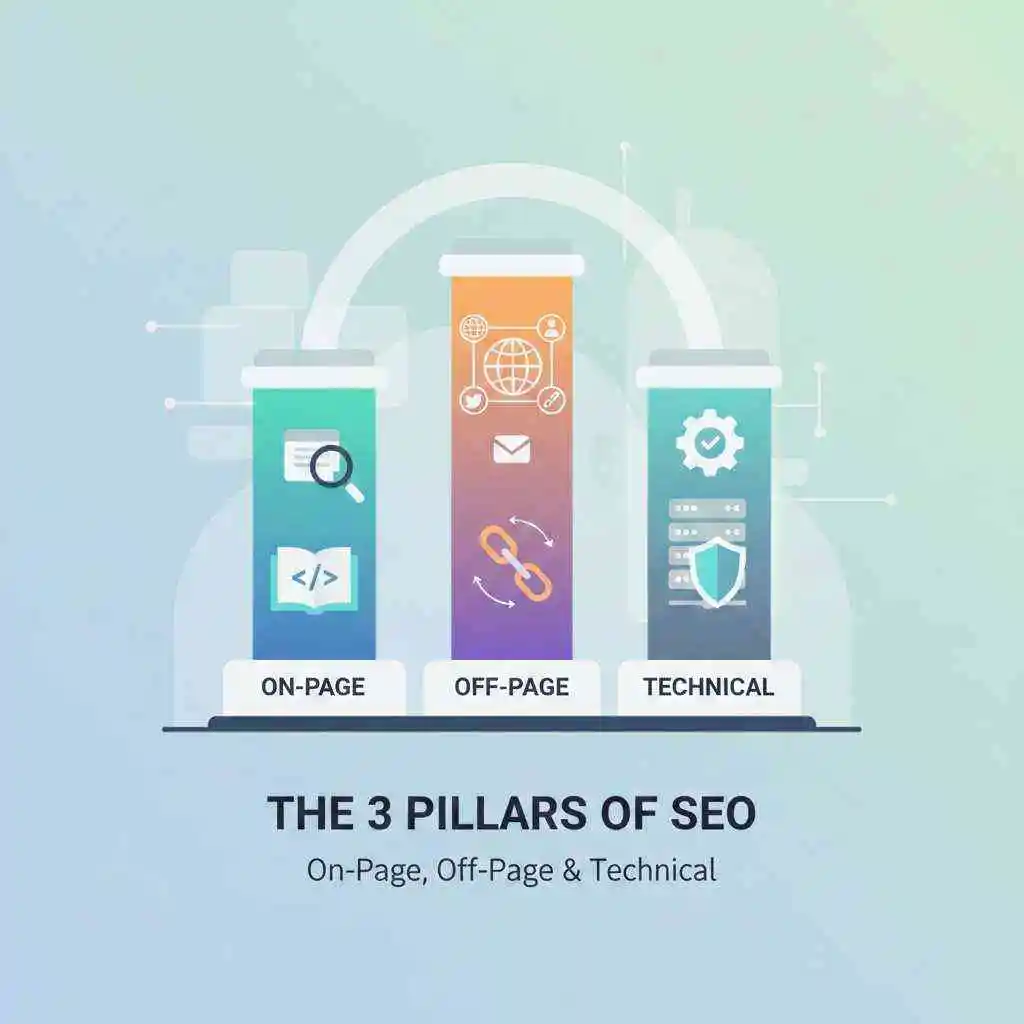
3 Pillars of SEO: On-Page, Off-Page & Technical (2026 Guide)
Master the 3 pillars of SEO: on-page optimization, off-page link building, and technical SEO. Complete guide with checklists for each pillar.


Search Engine Optimization (SEO) isn’t one single thing, it’s actually made up of three key parts. Think of your website like a store: on-page SEO is about organizing your shelves and signage, off-page SEO is getting glowing referrals and buzz outside your store, and technical SEO is the plumbing and wiring that keeps everything running smoothly. In this post, we break down each of these SEO pillars in plain language for startup founders. You’ll learn what on-page, off-page, and technical SEO really mean, why they matter, and actionable tips to improve your site’s visibility.
On-Page SEO: Optimize What You Control
On-page SEO is everything you do on your own website. This includes the text, images, and tags you control. It’s about writing great content that answers customers’ questions and using the right keywords in the right places. For example, adding target keywords naturally in your page titles, headings (H1, H2, etc.), and body content helps Google understand what your page is about. You should also craft clear meta titles and descriptions, think of these as ad copy that shows up in search results. Internal linking (linking to your own pages) is another on-page strategy: it spreads “page authority” around your site and helps visitors discover more of your content. On-page SEO also covers basics like using descriptive file names and alt text for images (so Google can “read” them) and writing clean, keyword-rich URLs.
-
Content Quality: Write helpful, original content that addresses your audience’s needs. Focus on solving their problems.
-
Keywords & Headings: Naturally include relevant terms in your titles, headings, and copy. Use H1/H2 tags strategically so readers (and Google) quickly see what each section covers. If you are stuck on the title tag itself, use a free SEO title generator to draft keyword-led variants.
-
Meta Titles & Descriptions: Craft concise, compelling titles and descriptions that incorporate your main keyword and invite clicks. You can write a meta description that gets clicks before publishing instead of leaving Google to invent the snippet.
-
Internal Links: Link related pages on your site with descriptive anchor text. This guides visitors and helps Google crawl your content.
-
Media & URLs: Use simple, descriptive URLs and add meaningful alt text to images. These small fixes improve crawlability and user experience. Before the page goes live, check your title and meta length so search snippets do not get cut off awkwardly.
*On-page SEO is something you control 100%. A well-optimized page clearly tells Google “this is exactly what we do.” As one analogy puts it, “think of your website as a storefront, and on-page SEO is how you make sure the lights are on, the shelves are well organized, and your best products are front and center.”
In other words, good on-page SEO makes your site user-friendly and easy to understand.
If you’re applying those same on-page SEO principles to an ecommerce site, the details matter even more across product pages, collection pages, image assets, URLs, and internal links. This Shopify SEO playbook breaks that process down into a practical checklist for store owners.
Off-Page SEO: Build Your Reputation
Off-page SEO is everything that happens off your site but still affects your ranking. The main factor here is backlinks, links from other websites pointing to yours. Backlinks are like word-of-mouth referrals for your business. When a respected site links to you, Google takes it as a vote of confidence in your content.
For a startup founder, off-page SEO means building your website’s reputation on the wider web. Key strategies include:
-
Link Building: Reach out to influencers, bloggers, and industry sites. Write guest posts or collaborate on content so they link back to your site. Remember, a single link from a reputable site can be more valuable than many low-quality links. Focus on creating content that others will naturally want to share (data reports, infographics, in-depth guides).
-
Earned Media (PR): Sign up for HARO (Help a Reporter Out) or similar services. By responding to journalist queries in your niche, you can earn free press links when your insight is used.
-
Content Promotion: Share your content on social media and tag relevant people or organizations. While social signals aren’t a direct ranking factor, a retweet or LinkedIn share can boost visibility. Sometimes a share by a bigger profile leads to new backlinks or mentions.
-
Community Engagement: Participate in forums or Q&A sites (like Reddit, Quora, StackExchange). Thoughtful, genuinely helpful answers that reference your blog can drive traffic and even earn links (just avoid spamming).
-
Brand Mentions and Reviews: Encourage satisfied users to leave positive reviews. Keep your business information consistent on directories (often called “citations”). Google values brand mentions, linked or not, as trust signals.
All these off-page tactics come down to one thing: providing value. As one SEO expert advises, “provide genuine value that others want to link to… then let the community reward you with organic links, tweets, and forum shout-outs.”
In practice, that means building relationships and focusing on quality over quantity. Over time, strong off-page SEO boosts your site’s authority, helping all your pages rank higher.
Technical SEO: Fix the Foundation
Technical SEO is the behind-the-scenes work that makes sure your site runs smoothly for both users and search engines. It covers site performance, security, and crawlability, basically, removing any roadblocks. If on-page SEO is your store’s display, technical SEO is the wiring and plumbing. Google has to be able to access and understand your pages.
Key technical tasks include:
-
Site Speed: Make your pages load quickly (aim for ~3 seconds or less). Compress images, minify CSS/JavaScript, and use browser caching or a CDN if possible. Fast-loading sites keep visitors happy, and Google explicitly uses page speed as a ranking factor.
-
Mobile Optimization: Ensure your site is responsive and works well on smartphones and tablets. Google’s index is mobile-first, so a poor mobile experience can hurt your rankings.
-
Secure Site (HTTPS): Use HTTPS with a valid SSL certificate. This encrypts data and is a minor ranking signal (it also builds user trust).
-
Clean Architecture: Use a logical URL structure and internal linking so Google can crawl your entire site. Maintain an up-to-date XML sitemap and submit it in Google Search Console.
-
Fix Errors: Regularly check for 404 errors, broken links, or duplicate content using Google Search Console or tools like Screaming Frog. Resolve these issues (e.g., redirect or update links) to ensure a smooth crawl.
In short, technical SEO is about clearing obstacles. A technically sound site “creates a better user experience, keeps visitors on your site longer, and signals to Google that your website is reliable”. Even simple fixes, enabling HTTPS, improving page speed, ensuring mobile-friendliness, can give your rankings a solid boost. One SEO guide likens technical SEO to “the plumbing and wiring in a house. You might not see it, but if it’s not done right, nothing else works the way it should.”
Bringing It All Together
None of these SEO types can do the job alone. Google expects your site to be strong across all fronts: content, reputation, and technical health. For example, great content (on-page) won’t help much if Google can’t crawl your pages (technical), and even a fast site won’t rank well if nobody trusts it (off-page). As one expert puts it, “a comprehensive SEO strategy isn’t going to pick just one type of SEO, but rather combines all of them… giving attention to each area will make your SEO stronger and far more effective.”
So how does a founder act on this? We like a simple workflow you can follow:
-
Connect: Link your website to Google Search Console to gather performance data.
-
Analyze: Identify your top keywords and pages. Look at the top 20–50 queries for which you get impressions or clicks.
-
Plan: For each opportunity, make a mini action plan (e.g. a one-week content plan). Decide if you’ll update an existing page or create a new post targeting that topic.
-
Publish: Execute your plan. Update content, tweak meta tags, add internal links, and publish any new articles. Keep a consistent schedule (even one post per week signals activity).
-
Grow: Monitor the results. Track ranking and traffic changes in Search Console. Small, steady SEO actions compound over time.
This loop, connect, analyze, plan, publish, repeat, mirrors what many paid SEO tools do. (For example, LLaMaRush automats this exact process: it “connects Search Console, analyzes the top keyword opportunities, and even generates a content plan and content… all on a single click”.) Even doing it manually, the principle is the same. Google rewards sites that stay active, it calls regular publishing and updates “daily activity”, so consistency is key.
Tools and Tips for Busy Founders
You don’t need to be an SEO expert to start. Learn the basics, track progress, and then bring in help or tools as needed. Here are some practical tips:
-
Use Google Search Console and Analytics (both free) to see which pages and keywords are already working for you.
-
Run your site through Google’s PageSpeed Insights or Lighthouse to find easy speed improvements.
-
Try a free crawl tool (like the free version of Screaming Frog) to spot broken links or missing tags.
-
Plan and batch your content. Even one new blog post every couple of weeks can make a difference in the long run, tools like LLaMaRush analyze, plan and publish piece of content everyday, which usually takes hours manually and hence boost your speed to rank.
-
Free SEO plugins or extensions (e.g., Yoast SEO, SEOquake) can prompt you to fix simple issues like missing alt tags or meta descriptions.
Even with limited resources, focus on fundamentals: write helpful content first, keep your site technically clean, and build genuine backlinks. As one SEO guide for startups emphasizes, “fast loading speed (under 3 seconds), mobile responsiveness, clear URL structure, and basic meta tags” are non-negotiable, and “off-page SEO success comes from genuine connections… Quality beats quantity every time.”.
In practice, a founder might start by fixing their main landing pages (on-page and technical fixes), then spend a few hours per month reaching out to partners or submitting HARO answers (off-page efforts). Over time, these small improvements stack up.
Conclusion
On-page, off-page, and technical SEO are like the three legs of a stool, all equally important. By writing great content, building a bit of external buzz, and keeping your site in tip-top shape, you create a virtuous cycle. These efforts compound over time, gradually lifting your search rankings and traffic.
Remember to focus on helping your customers at every step. Use clear language, answer real questions, and prioritize user experience. Google’s algorithms may change, but the fundamentals remain: valuable content, fast and accessible site, and trust signals (links and mentions). Keep at it consistently, and you’ll see your traffic climb, without draining your budget. Good luck, and happy optimizing!
Frequently Asked Questions
Q1: What are the 3 pillars of SEO and why do they matter for a startup?
A1: The three pillars of SEO are On‑Page SEO (optimizing content, titles, headings, and internal links on your own site), Off‑Page SEO (building backlinks, brand mentions, and reputation from other sites), and Technical SEO (improving site speed, mobile‑friendliness, crawlability, and security). They matter because Google evaluates all three together, great content won’t rank if your site is slow or uncrawlable (technical), and a fast site won’t rank without trusted backlinks (off‑page). For startups, balancing all three creates a solid foundation for sustainable organic growth.
Q2: What is the difference between on‑page and off‑page SEO?
A2: On‑page SEO refers to everything you control directly on your website, page titles, meta descriptions, headings (H1/H2), keyword usage, internal links, image alt text, and content quality. Off‑page SEO refers to external signals, primarily backlinks from other websites, but also brand mentions, social shares, guest posts, and directory citations. Think of on‑page as “what you say about yourself” and off‑page as “what others say about you.” Both are critical: on‑page tells Google what your page is about, while off‑page tells Google whether others trust and recommend it.
Q3: Which pillar of SEO should a beginner founder focus on first?
A3: Start with Technical SEO and On‑Page SEO first. Without a technically sound site (fast loading, mobile‑friendly, crawlable), Google may not index your pages properly. Then focus on on‑page elements: write high‑quality content that answers user questions, optimize titles and headings with relevant keywords, and build internal links between your posts. Off‑page SEO (backlinks) takes more time and relationships, so begin with simple tactics like HARO, guest posting, or niche directories once you have at least 5–10 solid content pieces. Prioritize: Technical → On‑Page → Off‑Page.
Q4: How can I improve technical SEO on my startup site without hiring a developer?
A4: Use free tools to identify and fix common issues: Google PageSpeed Insights (improve load time – compress images with Squoosh, enable caching), Google Search Console (check for crawl errors and mobile usability), and Screaming Frog (free up to 500 URLs to find broken links or missing meta tags). Ensure your site uses HTTPS (free SSL from Let’s Encrypt or Cloudflare). Choose a lightweight, responsive theme (most modern CMS themes are mobile‑friendly). Submit an XML sitemap to Google Search Console. All these fixes cost nothing but time and can dramatically improve your technical foundation.
Q5: Do I need backlinks for SEO if my on‑page and technical SEO are perfect?
A5: Yes, backlinks (off‑page SEO) are still essential. Even with perfect on‑page and technical SEO, Google uses backlinks as a primary trust and authority signal. Without any external links, your pages may struggle to rank for competitive or even moderately competitive keywords. However, for very low‑competition long‑tail keywords, you can sometimes rank with zero backlinks if your content is exceptional. As a startup, focus on earning a few quality backlinks over time (e.g., from HARO, niche directories, or guest posts) rather than hundreds of low‑quality links. A handful of relevant, editorial backlinks can significantly boost your rankings.
Thanks for reading! ❤️
Written by
SiddharthRead Next
What is SEO? Complete Beginner's Guide for Founders (2026)
SEO vs SEM vs Branding: Which Grows Your Startup Faster?
How Search Engines Work: SEO Basics Explained Simply (2026)

Automotive SEO: Get More Car Buyers & Service Clients

Solo Founder SEO: Grow Traffic with 5 Hours/Week (2026)
SEO vs SEM vs Branding: Which Grows Your Startup Faster?
Turn this into your AI Search strategy
LLaMaRush creates SEO, AEO, and GEO optimized content built to rank in Google and get cited by AI answer engines.
Start Ranking Everywhere