
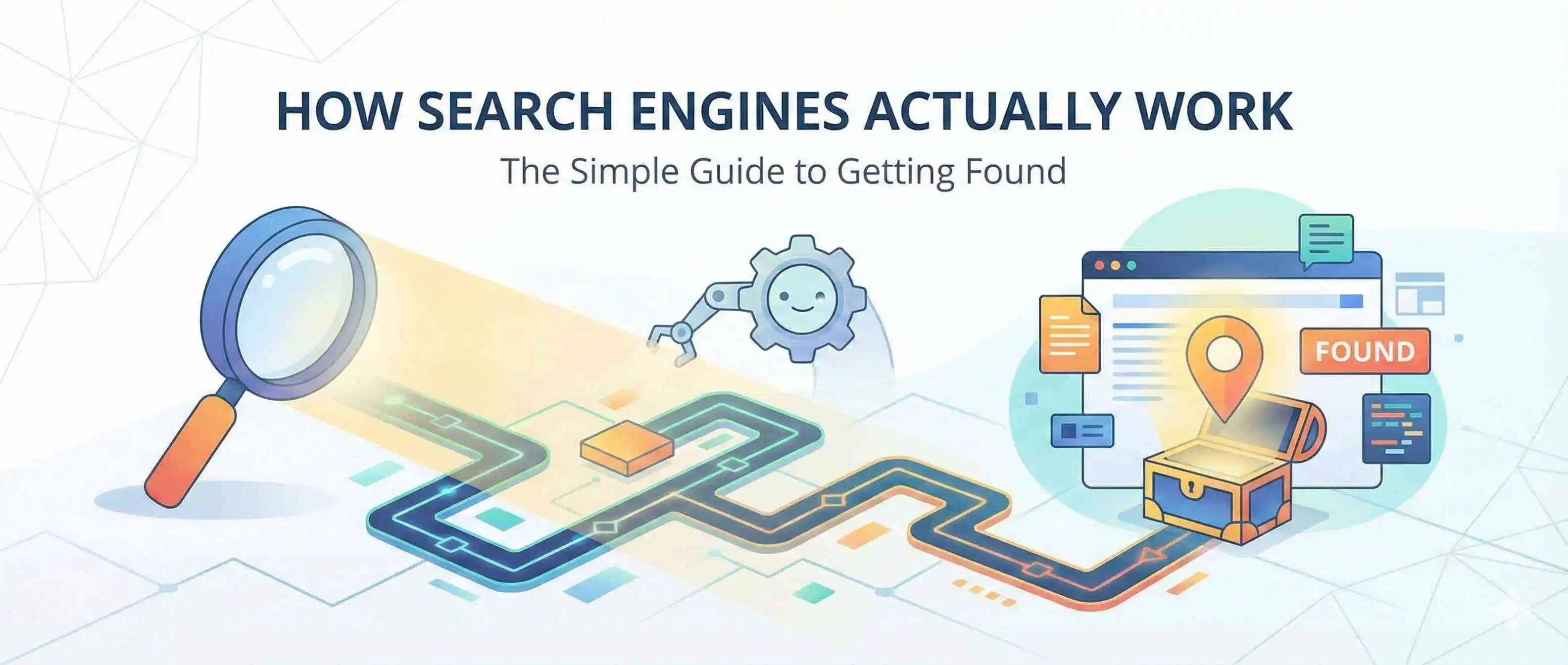
How Search Engines Work: SEO Basics Explained Simply (2026)
As a founder, you know you need to rank on Google. But let's be honest: the whole process can feel like a black box. You publish a page, cross your fingers, and hope the magic algorithm gods smile upon you.
What if you understood the gears turning inside that box? Not to become an expert, but to make smarter, more confident decisions about your website.
Forget the technical jargon. Think of a search engine not as a mysterious judge, but as an incredibly efficient, three-stage librarian for the entire internet. Its sole job is to:
1. Find every book (webpage),
2. Catalog them accurately,
3. Provide the perfect book for every visitor's question.
Here’s how that library runs, and exactly what you need to do at each stage to get your "book" chosen.
Stage 1: Crawling – The Endless Discovery Scout
Imagine a librarian sending out an army of tiny scouts (called crawlers or spiders). Their only mission is to endlessly explore, discovering new books and checking on old ones. They follow links from page to page, site to site, mapping the ever-growing web.
-
What Google's crawler (Googlebot) is thinking: "What pages exist? Have they changed since my last visit? Are there any new links to follow?"
-
Your Goal: Make sure the scout can find and access your pages easily.
Your Simple SEO Action Plan for Crawling:
-
Get on the Map: Submit your main website address (your sitemap.xml) to Google Search Console. It's like handing the librarian your library's master index.
-
Build Clear Pathways: Have a simple, logical site structure with internal links. Don't bury your best content ten clicks deep. The scouts follow links—make a trail for them.
-
Remove Roadblocks: Don't block crawlers in your robots.txt file by accident. In Search Console, use the "URL Inspection" tool to see exactly how Googlebot views your page.
-
Mind Your Speed: If your page takes forever to load, the scout might leave before it finishes reading. Page speed is a crawling (and ranking) factor.
Key Takeaway: Crawling is about accessibility. If Googlebot can't find or read your page, the race is over before it starts. Tools like GSC can help you with knowing which pages are indexed and which ones got issues.
Stage 2: Indexing – Filing the Pages in the Right Drawers
The scouts bring back the pages. Now, the librarian needs to analyze and file them. This is indexing. The engine processes the content-text, images, videos, code, and stores it in a massive, organized database. It understands the topic, keywords, and key elements of each page.
-
What Google's indexer is thinking: "What is this page really about? What are its main topics? Is it a product page, a blog post, or a tutorial? How fresh is the information?"
-
Your Goal: Ensure your page is understood clearly and deemed valuable enough to store.
Your Simple SEO Action Plan for Indexing:
-
Craft a Clear Title & Summary: Your HTML title tag and meta description are prime filing cabinet labels. Make them descriptive, include relevant keywords naturally, and compel a click.
-
Bad: "Home Page | MyStartup"
-
Good: "Project Management Software for Remote Teams | MyStartup"
-
-
Use Headers Like Chapters: Structure your content with clear H1, H2, H3 tags. It helps the engine follow your logical flow. Your H1 should be the main title of the "chapter."
-
Optimize Images & Media: Use descriptive file names (project-management-dashboard.png vs. IMG_1234.jpg) and alt text. This helps the engine "see" your images and file them for image search.
-
Signal Expertise: Demonstrate your content is trustworthy. Cite sources, show author credentials, and keep information updated. Google's E-E-A-T (Experience, Expertise, Authoritativeness, Trustworthiness) guidelines are all about the quality of your "filing."
Key Takeaway: Indexing is about clarity and quality. A well-structured, authoritative page gets filed accurately and is ready to be retrieved. An AI-driven audit from a tool can instantly flag pages with poor indexing signals, like missing titles or thin content.
Stage 3: Ranking – Choosing the Best "Book" for the Query
Now comes the magic. A user types in a question. The librarian (the ranking algorithm) sprint to the database, pulls out hundreds of potentially relevant "books," and sorts them in a split second to find the single best answer. It weighs hundreds of ranking factors.
-
What the ranking algorithm is thinking: "Of all the pages about 'project management software,' which one is the most relevant, authoritative, and useful for this specific searcher at this moment?"
-
Your Goal: Be the most relevant and helpful result for your target queries.
Your Simple SEO Action Plan for Ranking:
This is where your core marketing work pays off. The algorithm prioritizes:
-
Content Relevance & Quality: Does your page thoroughly and clearly answer the searcher's intent? Is it comprehensive, original, and well-written? This is the #1 factor.
-
Backlinks (External Links): Are other reputable sites linking to your page? This is the librarian seeing other experts recommend your book. It's a huge vote of confidence.
-
User Experience (UX): Is your page fast, easy to read on mobile, and secure (HTTPS)? Do people who click tend to stay ("dwell time") or bounce right back? Google measures these signals heavily.
-
Context & Personalization: Location, search history, and device can influence results. A search for "coffee shop" will prioritize local results.
Key Takeaway: Ranking is a competition on relevance, authority, and experience. You win by creating the best content and building a reputation (links, brand) around it.
Bringing It All Together: A Founder's SEO Workflow
Understanding this 3-stage process turns SEO from magic into a logical system. Here’s how to act on it:
-
Technical Foundation (Crawling/Indexing): Use Google Search Console religiously. Ensure your site is fast, mobile-friendly, and error-free. This is non-negotiable plumbing.
-
Content Creation (Indexing/Ranking): For every page or post, ask: "What specific question does this answer?" Craft your content to be the definitive answer. Use keywords naturally in titles, headers, and body text.
-
Authority Building (Ranking): You can't directly control this, but you can influence it. Create content so good that people naturally link to it (link-worthy content). Reach out for partnerships or mentions. Build your brand.
-
Iterate & Optimize: Use analytics to see what's working. Which pages rank? Which keywords bring traffic? Double down on that success.
The Modern Shift: AI & Search Engines
Today's search engines (especially Google) are blending their classic library system with AI language models. The goal is the same, find the best answer, but the methods are evolving. Search Generative Experience (SGE) aims to synthesize information directly. This makes your job even clearer: Create definitive, expert, trustworthy content that an AI would confidently cite as a source.
Conclusion: Stop Guessing, Start Engineering
SEO isn't about tricking a system. It's about aligning your website with the fundamental job of a search engine: to efficiently connect people with the best possible information.
Build for the crawler (make it accessible), write for the indexer (make it clear), and ultimately, create for the user (make it invaluable). Do that consistently, and the rankings will follow.
Next Steps: Open Google Search Console. Run a mobile-friendly test on your homepage. Check your top 5 pages for clear title tags and meta descriptions. You've just started actively engineering your visibility.
Frequently Asked Questions
Q1: How do search engines actually find my website pages?
A1: Search engines use automated programs called crawlers (or spiders, like Googlebot) that continuously follow links from page to page across the internet. They discover new pages and check for updates on existing ones. To help crawlers find your site easily, submit your sitemap via Google Search Console, build a clear internal linking structure (no page buried too deep), and ensure you’re not accidentally blocking crawlers in your robots.txt file. Think of crawling as the discovery stage, if crawlers can’t find your page, it can’t rank.
Q2: What is the difference between crawling, indexing, and ranking in SEO?
A2: These are the three core stages of how search engines work:
- Crawling : Search engines send bots to discover and scan webpages by following links.
- Indexing : The discovered pages are analyzed, understood, and stored in a massive database (the index). The engine figures out what each page is about (topics, keywords, structure).
- Ranking : When a user searches, the engine pulls relevant pages from the index and orders them based on hundreds of factors like relevance, authority (backlinks), and user experience.
For founders: ensure crawlability (technical SEO), indexability (clear titles/headings), and rankability (quality content + backlinks).
Q3: What factors help a webpage rank higher on Google?
A3: Google’s ranking algorithm considers over 200 factors, but the most important for beginners are:
- Content relevance & quality: Does your page thoroughly answer the user’s search intent?
- Backlinks: Links from other reputable sites act as “votes of confidence”.
- User experience (UX): Page speed, mobile‑friendliness, HTTPS security, and low bounce rates.
- On‑page elements: Title tags, headings (H1/H2), and keyword usage (natural, not stuffed).
- Freshness & authority: Updated content, author credentials, and trust signals (E‑E‑A‑T).
No single factor guarantees a top spot, it’s the combination.
Q4: Does Google use AI to rank search results in 2026?
A4: Yes. Google has integrated AI and large language models into its ranking systems, including the Search Generative Experience (SGE). AI helps Google better understand natural language queries, user intent, and even generate synthesized answers directly on search results. However, the fundamental three‑stage process (crawling → indexing → ranking) still applies. For website owners, this shift means you should focus even more on creating clear, expert, and trustworthy content that an AI would confidently cite as a reliable source. Avoid thin or generic content, AI models favor depth and authority.
Q5: How can a beginner check if Google has crawled and indexed their site?
A5: Use Google Search Console (free). After verifying your site, go to the “URL Inspection” tool and enter any page URL. It will show you:
- Whether the page is indexed (in Google’s database)
- When it was last crawled
- Any crawling or indexing issues (e.g., “Page with redirect,” “Not found,” “Excluded by noindex tag”)
You can also request manual indexing for new or updated pages. Additionally, check the “Coverage” report to see all indexed pages vs. those with errors. If your site isn’t indexed at all, submit your sitemap (e.g., yoursite.com/sitemap.xml) through Search Console. This is the first step to getting on Google’s radar.
Thanks for reading! ❤️
Read Next

Stop guessing your SEO strategy
LLaMaRush gives you data-driven content plans and automated insights to rank higher, faster.
Start Ranking Today